💡 Quick Summary: Key Selection Benchmarks for Converting Lines
When evaluating an automated disposable medical bed sheet or fenestrated drape machine, prioritize four core engineering criteria:
- Drive Architecture: 5-axis synchronized bus-type servo control over mechanical line-shafts to guarantee ≤ ±5 mm length repeatability.
- Aperture Tooling: Vacuum heat-treated DC53 cold-work die steel to eliminate frayed, burred cuts on abrasive SMS and PE substrates.
- Tension Management: Closed-loop magnetic powder brakes with active load-cell sensors for wide parent rolls up to 2000 mm.
- Economic Threshold: Target a payback period of under 8 months via a 75% labor reduction at stable 60–70 pcs/min output.
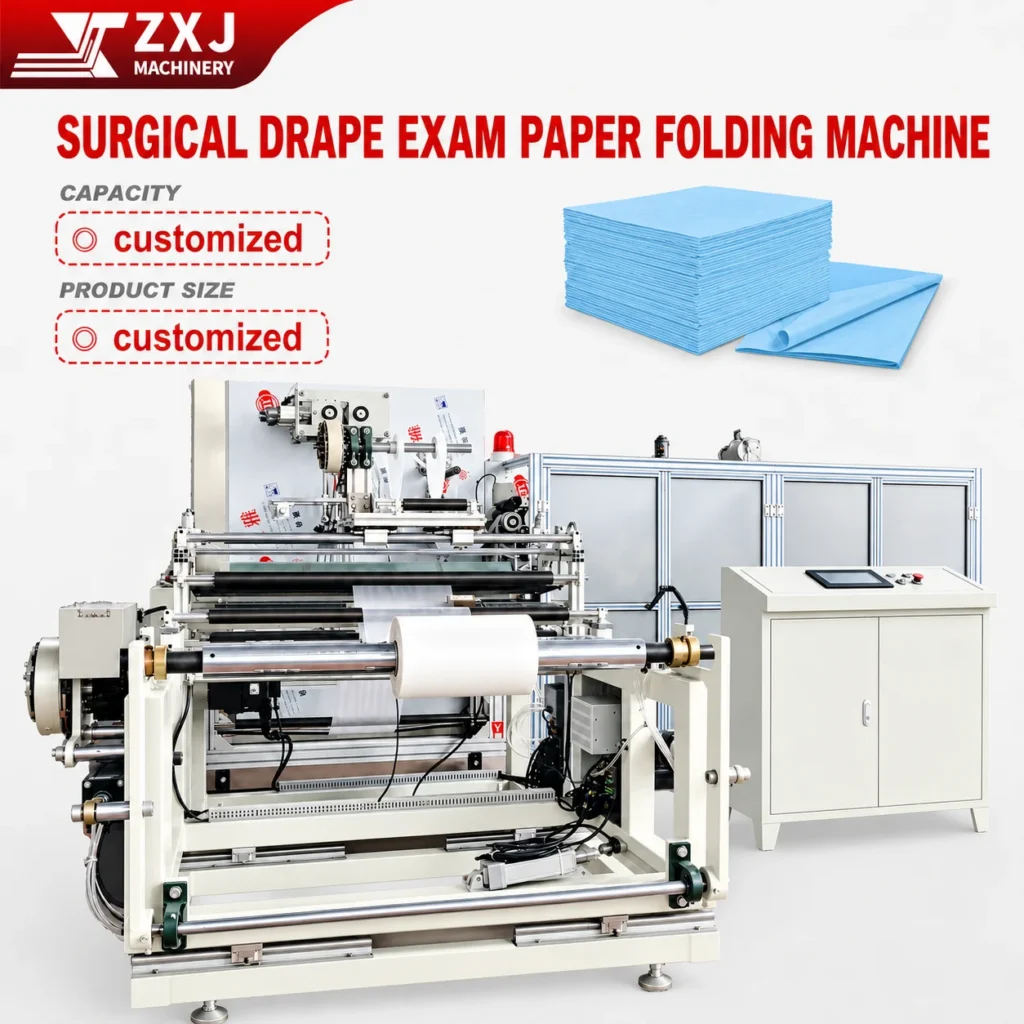
Global healthcare providers and surgical centers enforce rigorous standards for dimensional accuracy, fluid barrier integrity, and hygienic packaging in disposable consumables. For medical nonwoven converters, shifting from manual labor to high-speed automation is essential to preserving healthy operating margins.
However, sourcing an industrial disposable surgical drape folding machine or medical bed sheet folding machine requires auditing intricate mechanical, electrical, and motion control configurations. Equipment plagued by web tension drift, aperture cut deviations, or static cling creates costly raw material scrap and chronic downtime.
This technical guide provides plant directors, procurement managers, and business founders with an actionable evaluation framework, subsystem audits, parameter benchmarks, and quantified ROI calculations.
1. Key Engineering Criteria for Medical Sheet Converting
Medical converting lines handle delicate, lightweight nonwovens across wide web spans. When reviewing machinery specifications, factory technical teams must verify three primary capabilities:
[ Pneumatic Unwind ] ──► [ Magnetic Tension ] ──► [ Servo Aperture Die-Cut ]
                                                          │
[ Discharge / Stacking ] ◄── [ Transverse Fold ] ◄── [ Fan-Fold Forming ]
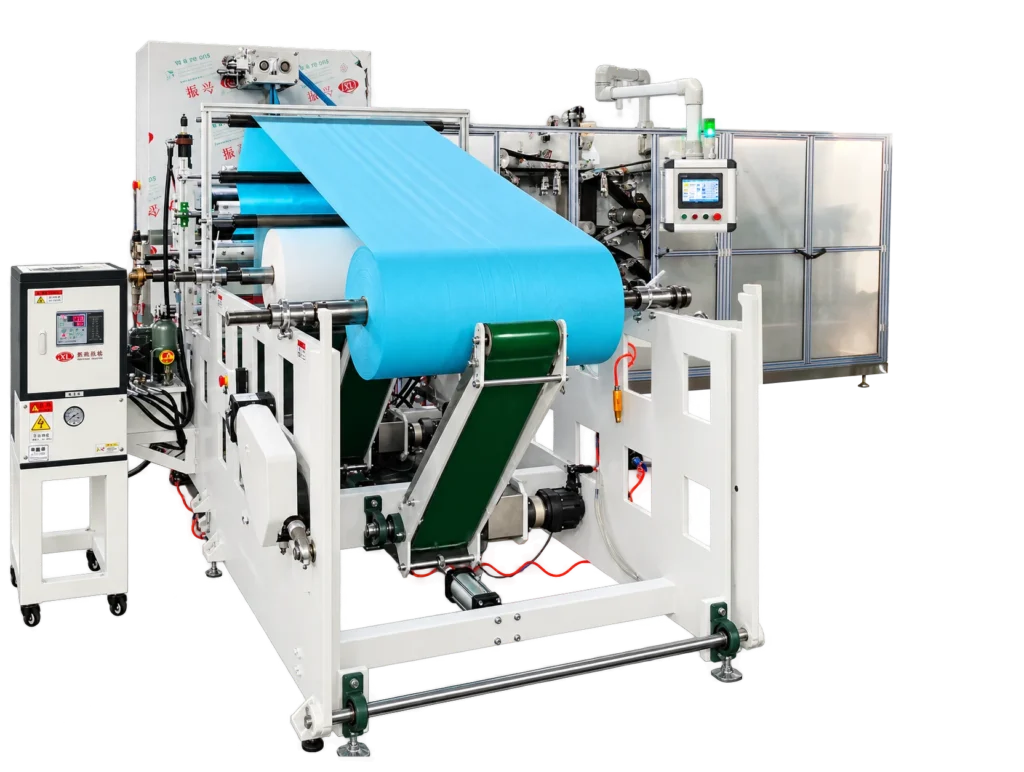
1.1 Wide-Web Tension Stability (Up to 2000 mm)
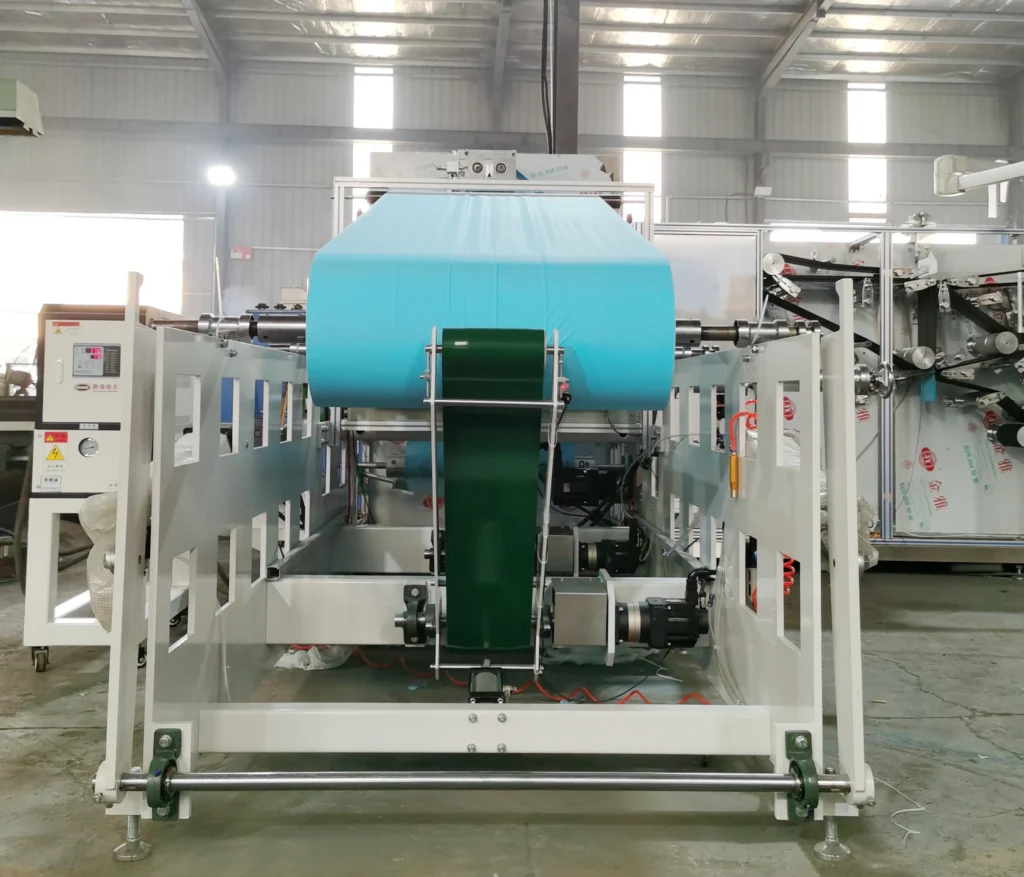
Medical bed sheets and surgical drapes utilize master roll widths ranging from 400 mm to 2000 mm, with roll diameters reaching 1200 mm. As the roll depletes, line speed and tension naturally fluctuate. Without active compensation, substrates stretch, neck down, or wander. Sourcing teams must ensure the unwind station features pneumatic shaft loading, high-response tension sensors, and closed-loop magnetic powder brake systems (such as Boquan) to maintain uniform web tension across the entire roll diameter.
1.2 Aperture Punching and Adhesive Synchronization
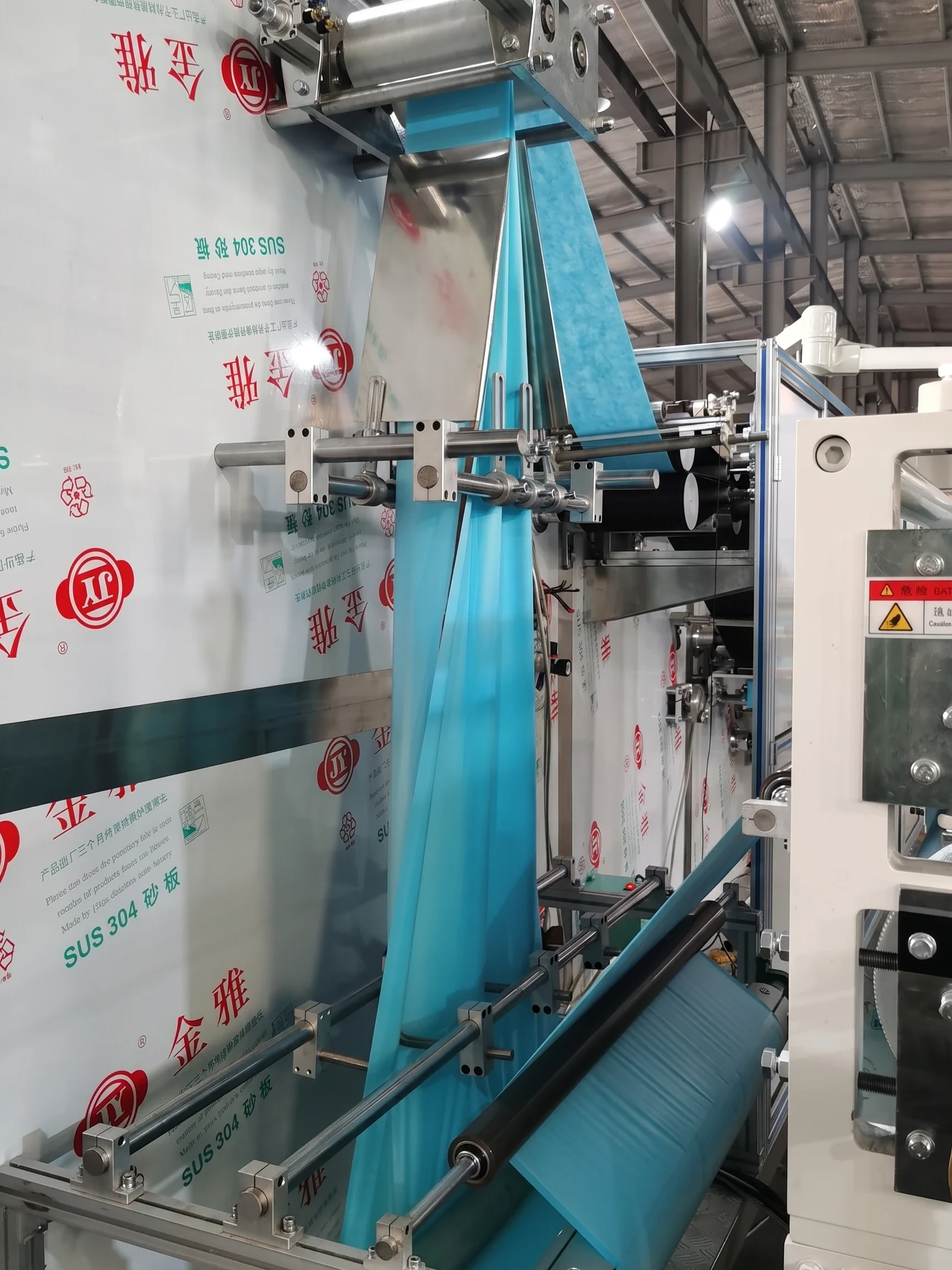
Surgical fenestrated drapes require precision-cut aperture holes with integrated medical adhesive strips to isolate surgical incision zones. Sourcing teams should confirm that the die-cutting unit operates via an independent servo drive. This enables micro-adjustments along the web directly from the touchscreen without stopping production. Furthermore, dual automated labeling units must synchronize with line encoders to apply double-sided release tape cleanly and reliably.
1.3 Versatile Multi-Layer Folding Configurations
Hospital supply contracts frequently demand varying fold styles across product lines. A flexible converting platform must support:
- Width Direction (Longitudinal): 4 to 10 adjustable fan-shaped layers or M-folds.
- Length Direction (Transverse): 2 to 4 consecutive servo-driven mechanical tuck folds.
- Finished Length Envelope: Continuous adjustment between 400 mm and 2400 mm, with cutting length tolerance held within ≤ ±0.5 cm (≤ ±5 mm).
2. Auditing Core Mechanical & Electrical Subsystems
A machine’s long-term Overall Equipment Effectiveness (OEE) and maintenance overhead are determined by its internal component architecture.
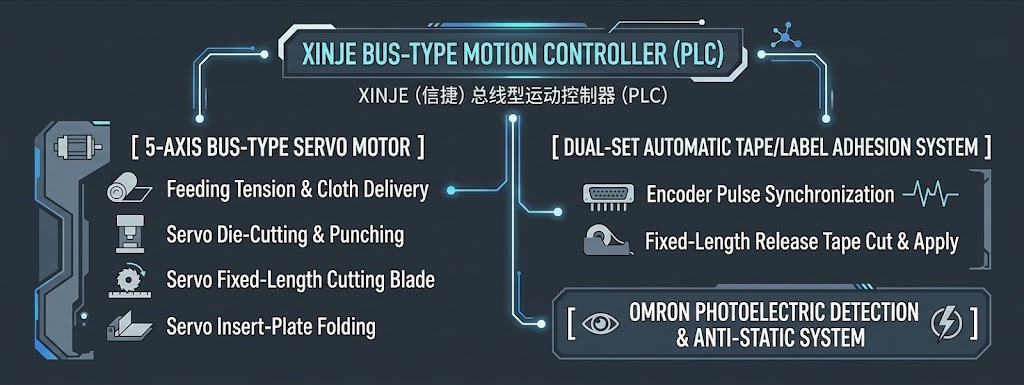
1. Multi-Axis Bus Servo Control vs. Mechanical Linkages
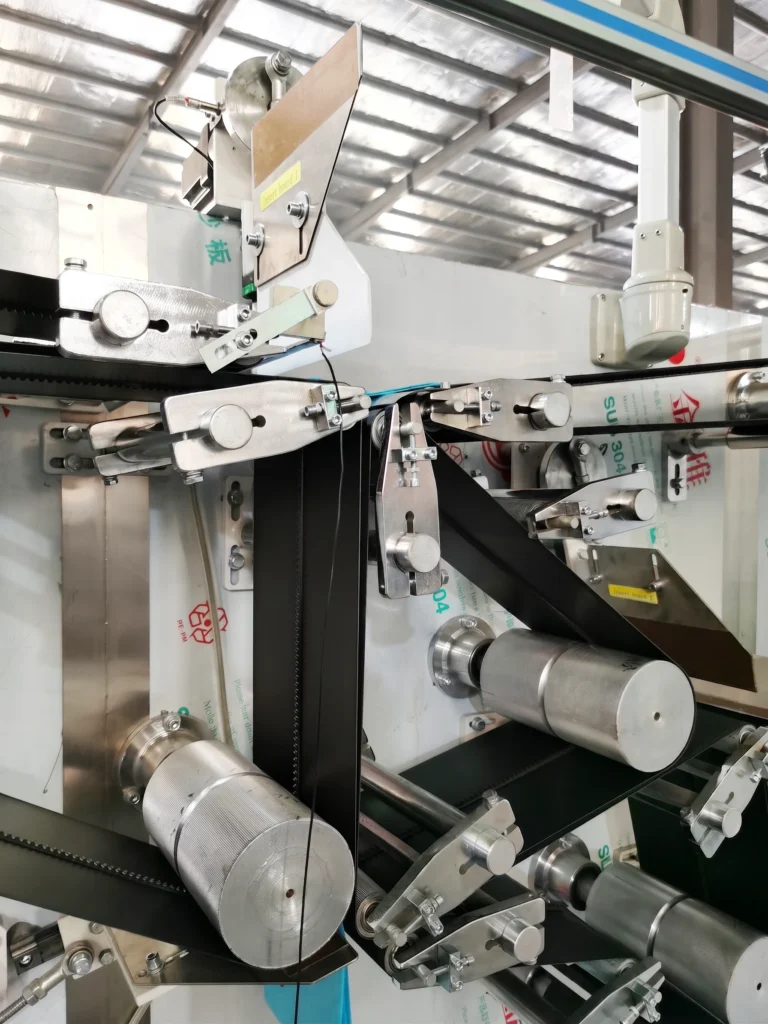
- Technical Configuration: 5-axis XINJE bus-type servo system paired with an industrial motion controller and a 10-inch color touchscreen HMI.
- Business & Operational Payoff: Eliminates mechanical chains, timing belts, and gears. Recipe changes for sheet length, fold count, and punch positioning take under 3 minutes via the touchscreen instead of 90 minutes of manual gear swapping, eliminating operator guesswork.
2. High-Durability DC53 Tool Steel Punching Dies
- Technical Configuration: Aperture dies machined from vacuum heat-treated DC53 cold-work tool steel.
- Business & Operational Payoff: Unlike standard carbon steel tooling that frays SMS and PE laminates after short runs, DC53 steel delivers superior wear resistance and edge retention. This extends die sharpening cycles by over 300%, reducing downtime and tooling costs.
3. Food/Medical-Grade Stainless Steel Contact Surfaces
- Technical Configuration: Material-contact parts—including adjustable M-formers, 5-layer top-opening former plates, and tucking knives—are manufactured from polished stainless steel. The chassis utilizes heavy-duty national-standard square tubing clad in stainless steel side panels.
- Business & Operational Payoff: Dampens mechanical vibration during high-speed operation, prevents surface oxidation, and complies fully with ISO Class 7/8 medical cleanroom protocols.
4. Dual Ionizing Static Control and Automated Stacking
- Technical Configuration: Discharge zone incorporates anti-static PU conveyor belts, active ionizing static eliminators, and an automated counting arrangement wheel.
- Business & Operational Payoff: Prevents electrostatic adhesion on synthetic nonwovens, eliminating line jams and delivering neatly counted stacks ready for automated packaging.
3. Technical Specification Matrix: YWJ-WS-CZ vs. Standard Converters
The table below contrasts the industrial-grade ZXJ Machinery YWJ-WS-CZ against conventional industry converting units:
| Specification Parameter | Standard Industry Folder | ZXJ Machinery YWJ-WS-CZ | Operational & Financial Advantage |
| Drive Architecture | Induction Motor / Pneumatic | 5-Axis Bus-Type Servo + Motion Controller | Zero mechanical slippage; micro-precise fold repeatability |
| Max Web Input Width | Up to 1200 mm | 400 mm – 2000 mm | Accommodates full-size surgical and bariatric drapes |
| Max Unfolded Dimensions | 1200 × 2000 mm | 1500 × 2400 mm | Broadest product capability on a single converting footprint |
| Non-Aperture Output Speed | 30 – 45 pcs/min | 60 – 70 pcs/min | Up to 55% higher throughput per working shift |
| Aperture Punching Speed | 20 – 35 cuts/min | 30 – 60 cuts/min | High-speed automated die-cutting with servo position trim |
| Aperture Tooling Material | Cr12MoV / Carbon Steel | DC53 Cold-Work Tool Steel | Extended blade life; reduced edge fraying on SMS/PE |
| Cut Length Accuracy | ±10 mm to ±15 mm | ≤ ±5 mm (≤ 0.5 cm) | Consistent dimensions for automated flow-wrapping lines |
| Static Control System | None / Optional Static Bar | Anti-Static PU Belts + Dual Ionizing Eliminators | Zero static jams during automated sorting and counting |
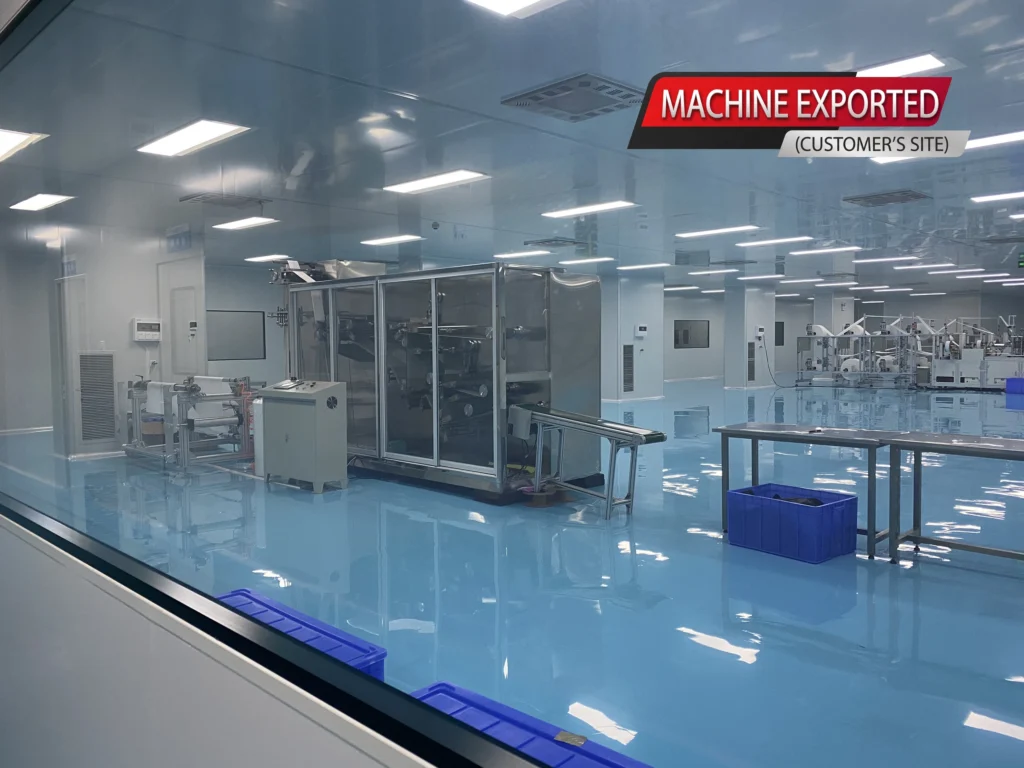
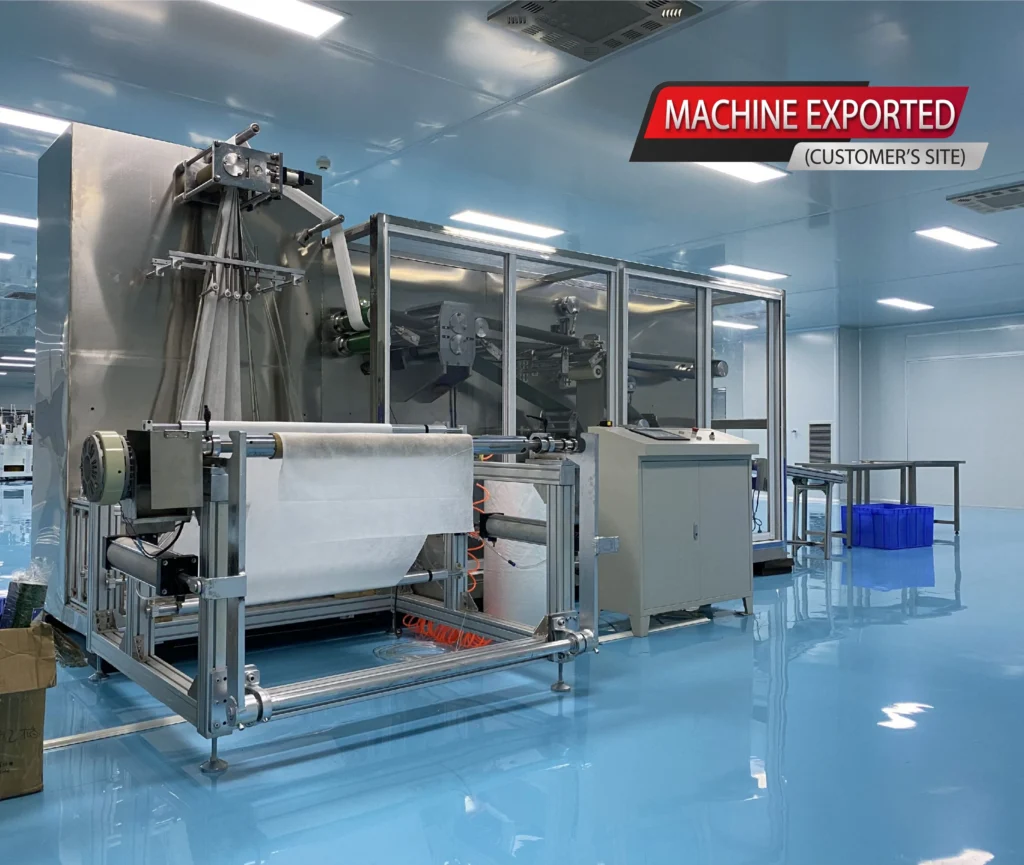
4. Total Cost of Ownership (TCO) and ROI Calculation
In machinery investment, the initial purchase price (CapEx) represents only a fraction of total costs. Operational expenditures (OpEx)—principally direct labor and substrate scrap—dominate long-term profitability.
Manual Cell (4 Workers @ 18 pcs/min) ──► High Labor Cost + 3.5% Scrap
                                  VS.
YWJ-WS-CZ Line (1 Operator @ 65 pcs/min) ──► 75% Labor Reduction + <0.8% Scrap
4.1 Direct Labor Reduction Model
A standard semi-automatic or manual folding cell requires 4 operators (unwinding, punching, manual folding, and counting) to generate approximately 18 sheets per minute (1,080 pcs/hour).
The automated YWJ-WS-CZ requires just 1 operator to oversee roll changes and monitor output, producing an average of 65 sheets per minute (3,900 pcs/hour):
- Daily Labor Savings Formula: (Manual Operators – Automated Operators) × Hourly Wage × Shift Hours
- Daily Calculation: (4 – 1) × $22/hour × 8 hours = $528/day
4.2 Annualized Payback & Financial Return
- Annual Direct Labor Saved (250 single-shift days): $132,000
- Material Scrap Reduction: Decreasing nonwoven scrap from 3.5% to under 0.8% saves an estimated $18,500 annually in raw SMS and PE film stock.
- Total Annual Economic Benefit: $150,500
- Estimated Machine Payback Period: 5.5 to 8 months under standard single-shift production.
5. Frequently Asked Questions (FAQ)
Can one machine handle both plain medical sheets and fenestrated drapes?
Yes. Modern converting lines like the YWJ-WS-CZ feature modular quick-change formers (an adjustable M-type former and a dedicated top-opening 5-layer former). Operators can toggle the servo aperture punching and adhesive taping modules on or off directly on the touchscreen, maximizing factory asset utilization.
What raw material substrates are compatible with this equipment?
The equipment processes all standard medical substrates between 25 gsm and 80 gsm, including Spunbond-Meltblown-Spunbond (SMS/SMMS) nonwovens, Polypropylene (PP) spunbond, viscose/polyester spunlace, airlaid dust-free paper, and PE-laminated fluid-barrier films.
What utility supplies are required for installation?
The system requires an electrical connection of 380V / 50Hz (customizable to 220V / 480V 3-Phase) with a total power load of 18 kW. A clean, dry compressed air supply (≥ 0.6–0.8 MPa) is required to operate pneumatic shafts, cylinders, and labeling applicators.
How does ZXJ Machinery handle international FAT, shipping, and commissioning?
Every machine undergoes a strict 48-hour continuous Factory Acceptance Test (FAT) prior to shipment. Buyers receive 4K test-run videos and full dimensional inspection reports. Equipment ships in protective vacuum-sealed packaging inside heavy-duty wooden crates, supported by comprehensive video tutorials, detailed wiring diagrams, and optional on-site engineering dispatch.
6. Sourcing Consultation & Next Steps
Selecting the right medical converting equipment requires matching your product specifications with reliable mechanical engineering and precision motion control.
ZXJ Machinery (Lianyungang Zhixinjie Machinery Co., Ltd.) provides over 30 years of specialized manufacturing experience, holding ISO9001 certification, CE conformity, and over 30 patents in automated nonwoven converting.
Ready to Modernize Your Medical Nonwoven Production?
- 🧪 [3-Step Free Sample Testing Protocol]: Send us your raw SMS/PP roll stock. We will convert custom-folded samples, record a 4K test-run video, and express-ship finished samples for your QA inspection.
- 📹 [Live Video FAT Demonstration]: Schedule a 1-on-1 virtual factory walkthrough with our senior automation engineers.
👉 [Request a Custom Proposal & Factory-Direct Price Quote →]
📩 Get a Quote / Contact Us
for machine specifications, video demonstrations, and a detailed quotation.
WhatsApp: +86 158-9610-9075
Email: paul@zxjmachinery.com