⚡ Quick Summary (Key Takeaways for Decision-Makers)
End-to-End Automation: The modern surgical drape manufacturing process converts raw jumbo nonwoven rolls (SMS/SMMS/Laminated PE) into precision-folded, sterile-ready drape packs at line speeds up to 70 pcs/min.
Core Kinematic Stages: Involves 6 synchronized stages: Constant tension unwinding (deviation < ±1.0 mm) → Inline servo rotary fenestration (die-cutting) → Adhesive tape/border application → Multi-lane longitudinal folding (V/W/Accordion) → Rotary cross-shearing & transverse folding → Auto-counting batch stacking.
Material Yield & Waste Reduction: Automated inline converting raises fabric utilization to 98.2%–99.1%, saving 7%+ raw material scrap compared to manual cutting tables.
Cleanroom & Standard Compliance: Engineered for ISO Class 8 (100,000) cleanroom operations, meeting stringent EN 13795 and AAMI Level 3/4 surgical barrier standards.
The global transition toward single-use medical textiles has elevated disposable surgical drapes and fenestrated hole towels from standard hospital supplies to mission-critical infection control barriers. In operating theaters, surgical drapes must provide fluid repellency, microbial barrier properties, and precise anatomical aperture positioning. For medical consumable manufacturers and project investors, building a compliant, high-output production line requires a deep engineering understanding of the automated surgical drape manufacturing process.
Transforming multi-layer nonwoven raw materials into sterile, fold-consistent surgical drapes demands high-precision tension management, inline die-cutting, and synchronized folding mechanisms. Below is a comprehensive engineering breakdown of the industrial manufacturing process using modern continuous converting technology.
1. Raw Material Selection: SMS, SMMS, and Laminate Structures
The converting process begins with substrate selection. Surgical drapes and hospital bed sheets rely primarily on composite synthetic nonwovens engineered to meet international barrier standards (such as EN 13795 and AAMI PB70):
- SMS/SMMS Nonwovens (35–60 gsm): Spunbond-Meltblown-Spunbond composites offer high tensile strength from the outer spunbond layers and liquid/bacterial filtration from the inner meltblown web.
- Laminated PE/PP Films: Impervious dual-layer laminates combining absorbent tissue or nonwoven facing with a polyethylene backing to prevent strike-through in high-fluid procedures.
- Spunlace Nonwovens (40–70 gsm): Soft, highly absorbent hydroentangled fibers commonly used for patient-contact surgical towels and fenestrated drapes.
Processing these delicate, low-elongation webs at high line speeds requires stable unwind mechanics to avoid necking, creasing, or tearing.
2. Web Infeed and Constant Tension Unwinding
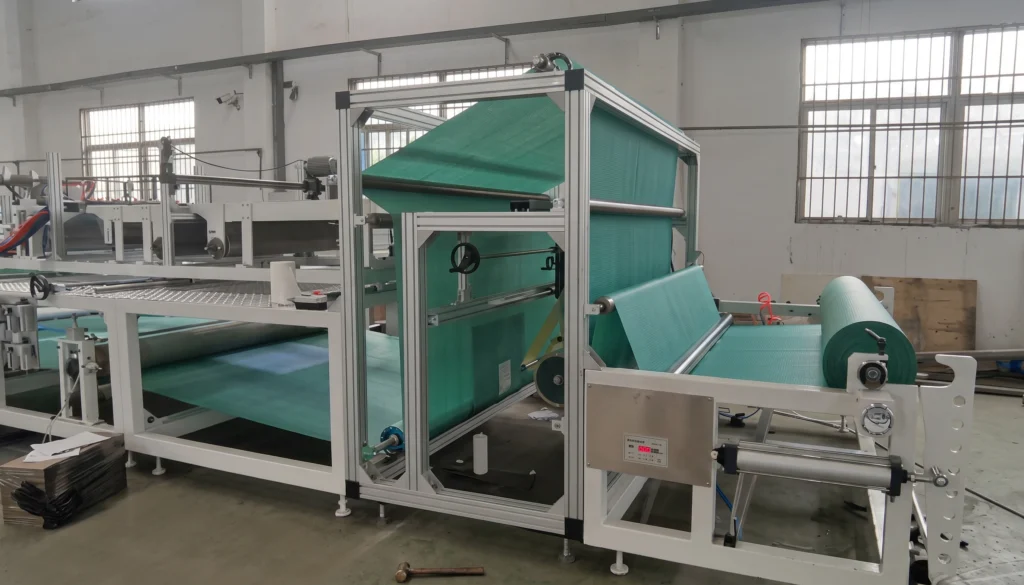
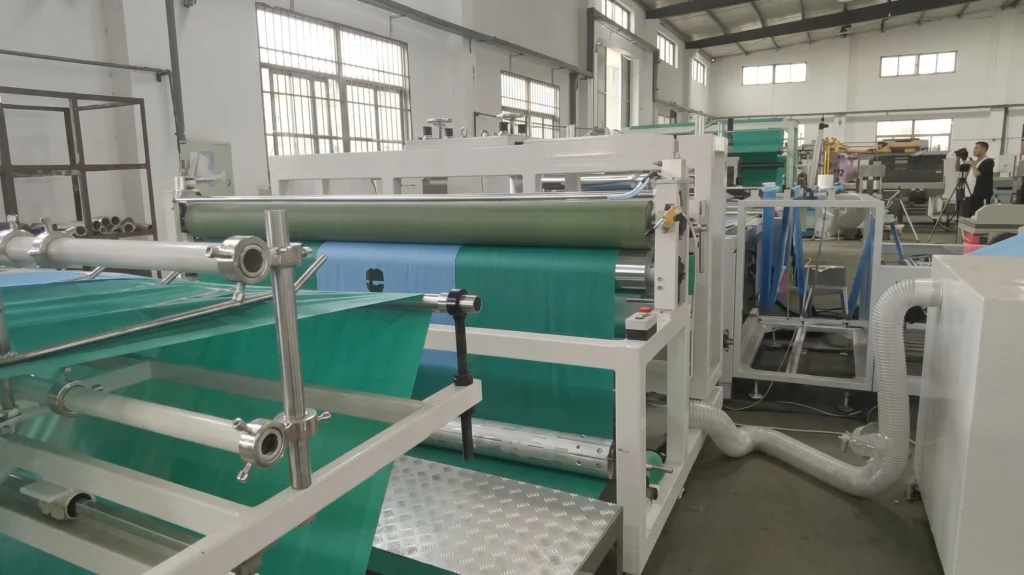
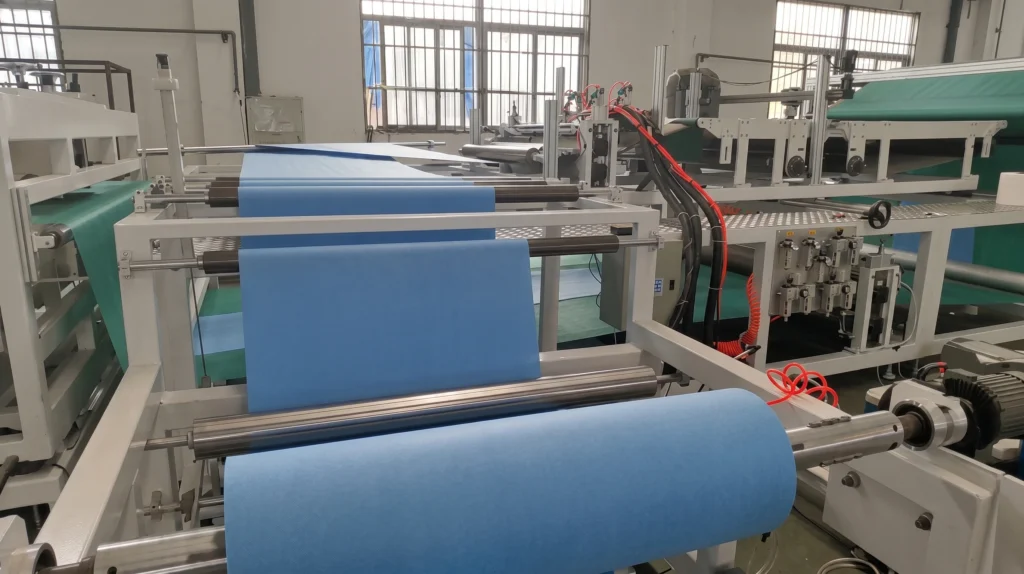
Continuous converting starts at the unwinding station, where master jumbo rolls (widths up to 2,000 mm and diameters up to 1,200 mm) are loaded onto pneumatic expansion shafts.
[ Jumbo Roll Unwind ] ──► [ Magnetic Powder Brake ] ──► [ Ultrasonic Web Guide (EPC)] ──► [ Web Infeed ]

·Active Tension Regulation: Magnetic powder braking systems paired with closed-loop tension controllers regulate braking torque as the parent roll diameter diminishes. This maintains uniform line tension within ±1.5% variance.

·Ultrasonic Edge Position Control (EPC): High-response web aligners continuously detect edge positions and dynamically adjust the cantilevered unwinding arbor, preventing lateral drift greater than ±1.0 mm.

·Static Elimination: Integrated ionization bars neutralize static charges generated during unwinding, preventing airborne particulate attraction and layer clinging.
3. Inline Fenestration: Precision Die-Cutting and Waste Extraction
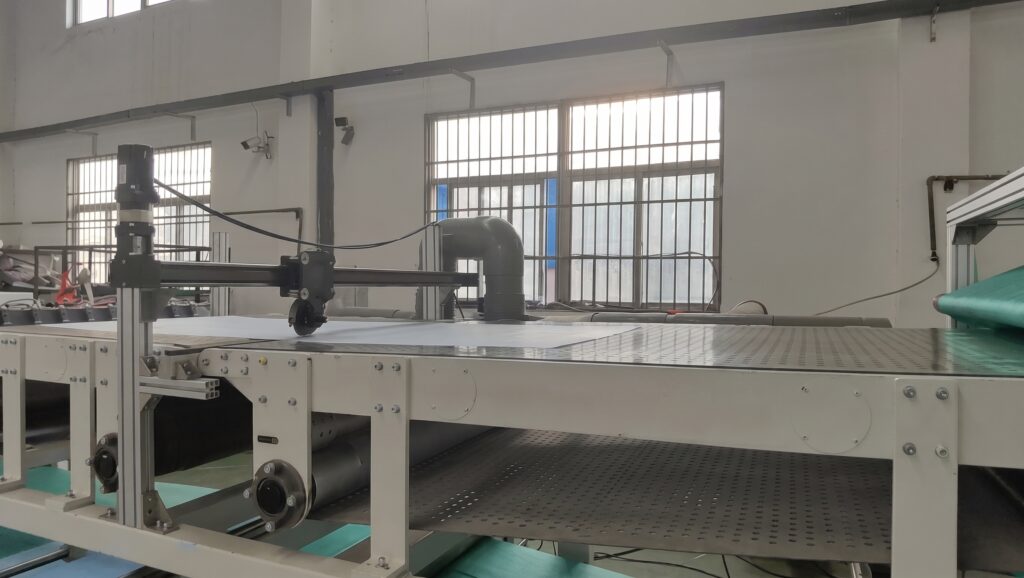
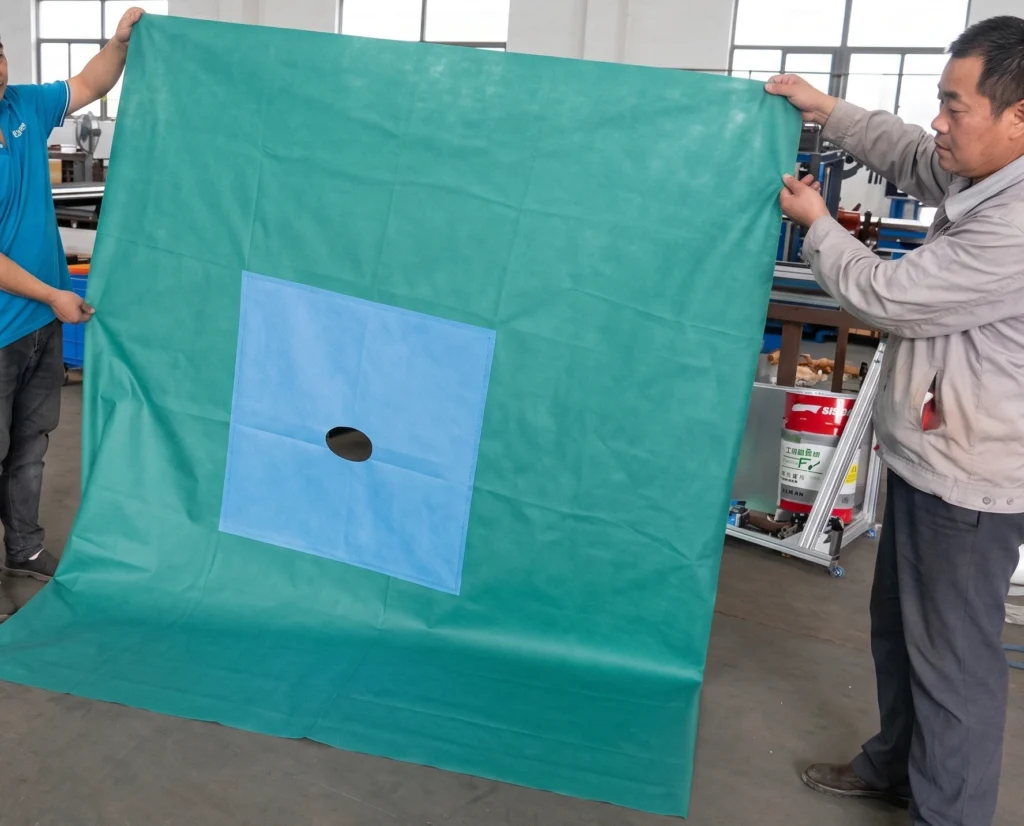
For fenestrated drapes (hole towels), aperture creation is the most critical mechanical step. In modern continuous lines like the YWJ-WS-CZ automated converting system, this is executed inline without halting web progression.
- Servo-Driven Rotary Die-Cutters: The machine utilizes hardened DC53 or tungsten carbide rotary cutting dies mated against an anvil roller. Cutting depth is calibrated to slice cleanly through multi-layer SMS without thermal melting or fiber fraying.
- Variable Aperture Tooling: Quick-change tool sleeves allow operators to produce circular, oval, or rectangular fenestrations (e.g., Ø50 mm to 200×200 mm) to match surgical specialties (laparoscopy, ophthalmic, extremity).
- High-Volume Vacuum Suction: Cutout offcuts are instantly captured by synchronized negative-pressure nozzles and routed into a dedicated collection bin, eliminating loose debris in cleanroom environments.
4. Reinforcement and Adhesive Border Application (Optional Module)
High-fluid surgical drapes frequently require localized liquid absorption and adhesive skin-fixation borders surrounding the aperture:
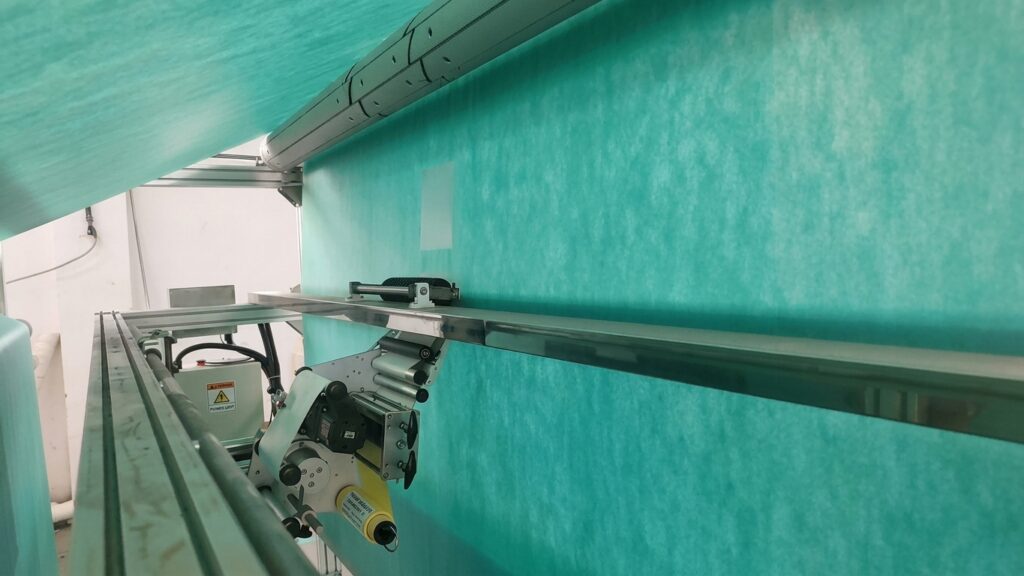
- Incision Drape Lamination: An integrated feeder applies a medical-grade transparent polyurethane film coated with hypoallergenic pressure-sensitive adhesive (PSA) over the fenestration.
- Release Liner Application: Double-sided medical release tape is applied around the drape perimeter or aperture, enabling surgical staff to affix the drape securely to the patient’s skin without shifting during surgery.
5. Multi-Stage Longitudinal and Transverse Folding
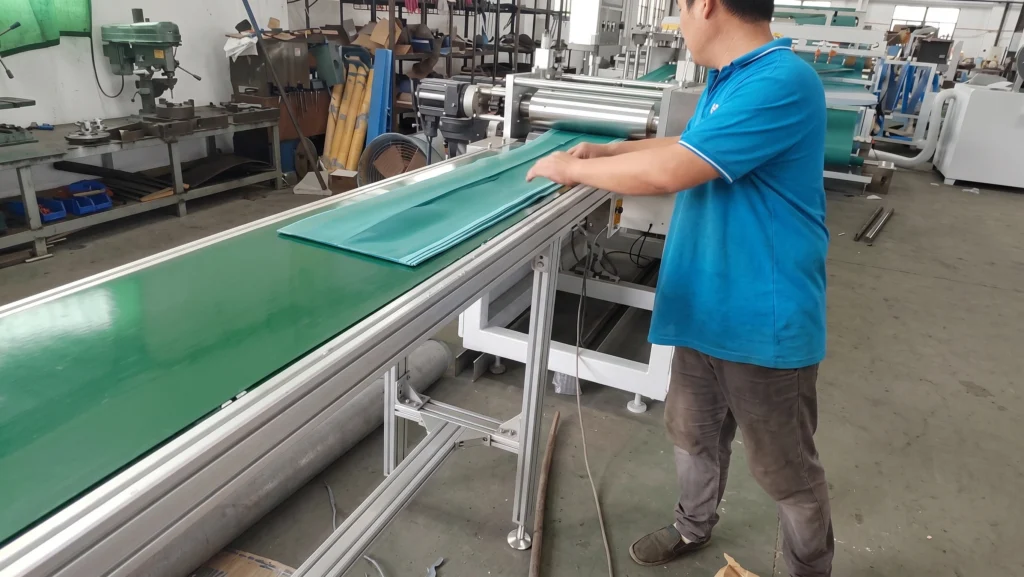
Converting broad 2,000 mm fabric webs into compact, hospital-ready packets requires a two-stage sequential folding process.
Stage A: Longitudinal Folding
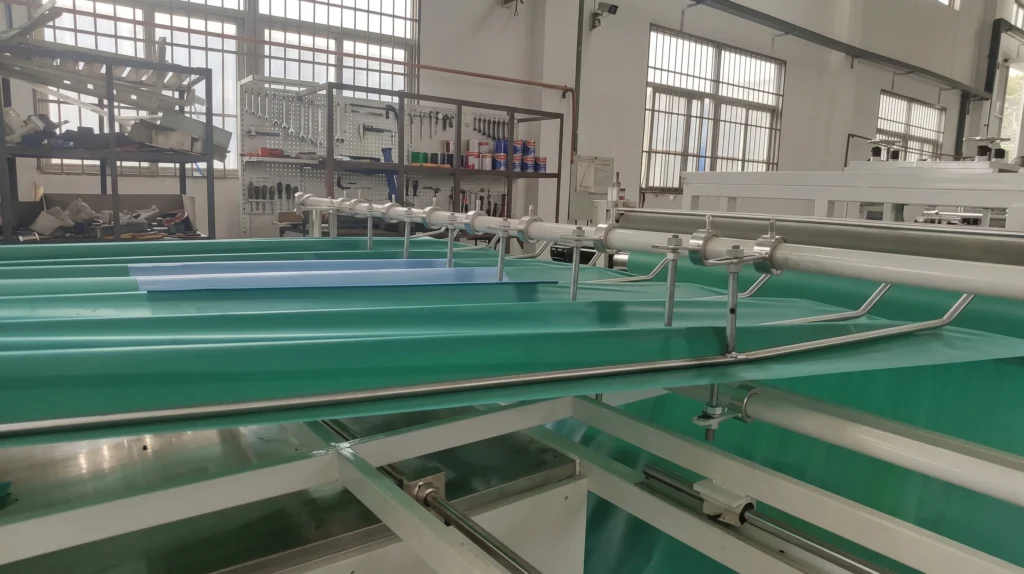
The web enters adjustable triangular forming boards or folding plates, executing single or multi-lane longitudinal configurations:
- V-Fold / C-Fold: Standard center or double-edge inward tucking.
- Concertina (Accordion/Fan) Folding: Multi-flute pleating that allows surgical personnel to rapidly expand the drape across the operating table with a single pull.
Stage B: Rotary Cross-Cutting & Transverse Folding
- High-Speed Rotary Shearing: Serrated alloy blades cut the continuously folded strip into preset lengths (ranging from 600 mm to 2,500 mm) with an accuracy of ±2.0 mm.
- Mechanical / Vacuum Blade Folding: A high-speed insertion blade drives the severed sheet between counter-rotating nip rollers, completing the final transverse fold (half-fold, quarter-fold, or 1/8 compact pack fold).
6. Synchronized Stacking, Automatic Counting, and Packaging Hand-Off
Once folded, the sheets transition to the delivery table:
- Optical Counting Sensor: Photoelectric sensors verify each piece as it drops onto the synchronous conveyor.
- Indexing Stacker: Upon reaching the programmed batch count (e.g., 5, 10, or 20 pcs per bundle), the servo conveyor steps forward to create distinct physical separations between stacks.
- Downstream Integration: Stacks transition to automated flow wrappers, blister sealers, or pouch sealers, preparing the goods for downstream turnkey sterilization and packaging integration.
Key Stage Parameters & Quality Control Matrix
| Process Stage | Core Mechanical Component | Critical Controlled Parameter | Tolerance / Target |
| Unwinding | Pneumatic air shaft & magnetic brake | Web tension & edge tracking | Deviation < ±1.0 mm |
| Fenestration | DC53 rotary die-cutter + anvil roll | Cut aperture edge sharpness | Zero fraying; position < ±1.5 mm |
| Longitudinal Fold | Stainless forming boards & guide rollers | Flute symmetry & fold tightness | Overlap tolerance < ±2.0 mm |
| Cross Cutting | Serrated tungsten carbide rotary knife | Cut length accuracy | Length error < ±2.0 mm |
| Transverse Fold | Servo mechanical folding blade | Final packet compactness | Dimensional variance < ±3.0 mm |
| Stacking | Photoelectric counter & servo belt | Pack piece count verification | 100% count accuracy |
Material Yield Efficiency: Automated vs. Manual Converting
Manual cutting and folding of surgical drapes introduces high material waste due to operator measurement error and inconsistent offcut trimming. Automated inline converting significantly improves material utilization:
Material Yield (%) = (Net Product Area / Gross Input Fabric Area) × 100%
Manual Table Processing: Yield averages 88.0% – 91.5% due to irregular edge cutting and sheet misalignments.
YWJ-WS-CZ Automated Line: Yield reaches 98.2% – 99.1%, reducing raw material scrap by over 7%. On an annual consumption of 500 tons of SMS fabric, this translates directly to $35,000–$55,000 in raw material savings.
Frequently Asked Questions (FAQ Schema Ready)
Q1: What raw materials are most commonly used in automated surgical drape manufacturing?
The industry standard is SMS (Spunbond-Meltblown-Spunbond) or SMMS polypropylene nonwovens ranging from 35 to 60 gsm. For high-fluid procedures, PE-film laminated nonwovens or hydroentangled spunlace fabrics are used to provide combined fluid absorption and impermeable barrier protection.
Q2: How does inline fenestration prevent fraying on nonwoven hole towels?
Precision rotary die-cutters manufactured from high-hardness DC53 or tungsten steel apply precise shear pressure against an anvil cylinder. Combined with sharp blade geometry, this cleanly shears the synthetic fibers without pulling or heat-fraying.
Q3: What cleanroom standards apply to surgical drape converting workshops?
Most medical regulatory bodies (ISO 13485, CE Medical Devices) mandate that surgical drape converting and primary packaging occur in an ISO Class 8 (Class 100,000) cleanroom environment with controlled positive air pressure, humidity, and static elimination.
Q4: Can a single machine produce both plain medical bed sheets and fenestrated drapes?
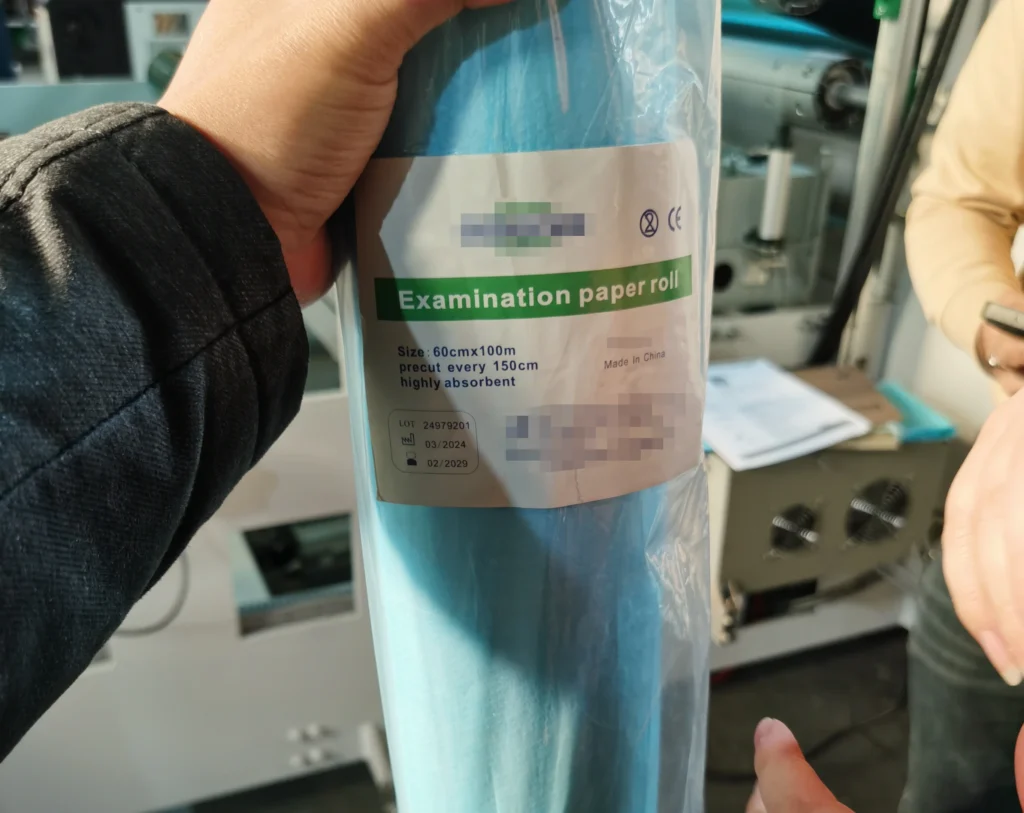
Yes. By disengaging or bypassing the rotary die-cutting station via the PLC touch screen, modern convertible lines can switch from fenestrated surgical hole towels to continuous plain medical examination sheets and hospital bed sheets in less than 15 minutes.
Technical Consultation and Line Configuration
Engineering a compliant, high-output medical converting line requires aligning machine kinematics with your target substrate specifications. Consult our engineering team to review detailed technical parameters for our converting equipment when evaluating folding machine mechanical specifications. Contact us today for CAD layout configurations, material testing, and factory-direct equipment quotations.
Global healthcare providers and surgical centers enforce rigorous standards for dimensional accuracy, fluid barrier integrity, and hygienic packaging in disposable consumables. For medical nonwoven converters, shifting from manual labor to high-speed automation is essential to preserving healthy operating margins.
However, sourcing an industrial disposable surgical drape folding machine or medical bed sheet folding machine requires auditing intricate mechanical, electrical, and motion control configurations. Equipment plagued by web tension drift, aperture cut deviations, or static cling creates costly raw material scrap and chronic downtime.
This technical guide provides plant directors, procurement managers, and business founders with an actionable evaluation framework, subsystem audits, parameter benchmarks, and quantified ROI calculations.
For detailed specifications and model options, visit our
🔗evaluating folding machine mechanical specifications
🔗Hemostatic Gauze Folding Machine:Technical Guide
📩 Get a Quote / Contact Us
for machine specifications, video demonstrations, and a detailed quotation.
WhatsApp: +86 158-9610-9075
Email: paul@zxjmachinery.com