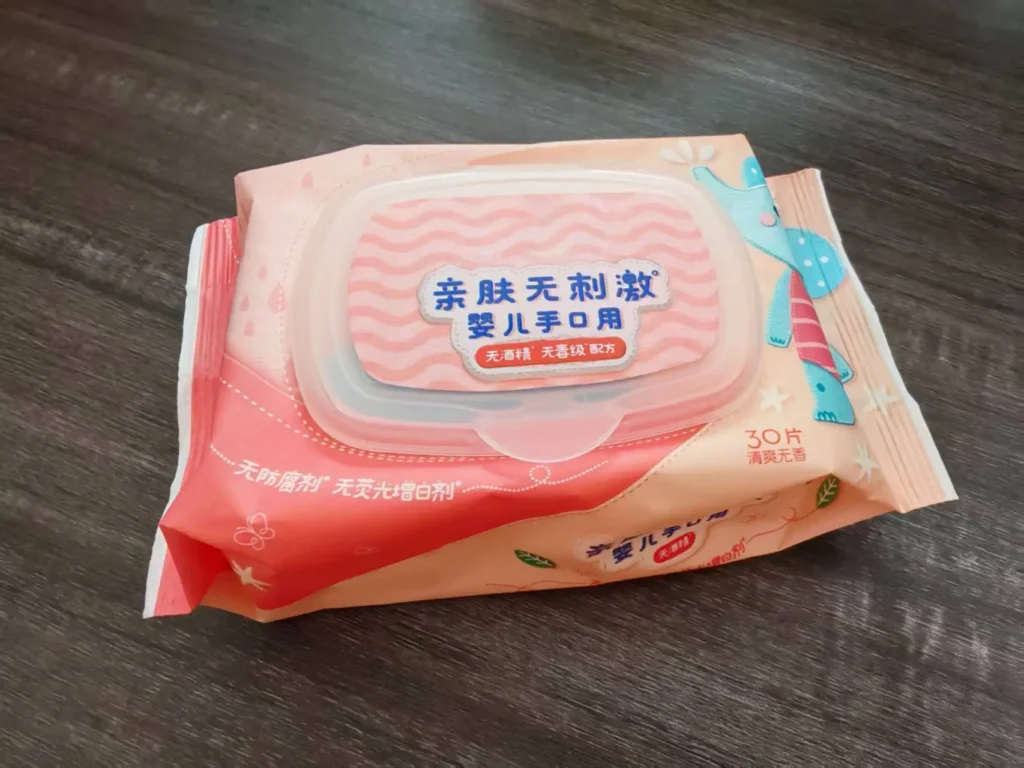
Driven by convenience retail, airline amenities, and antibacterial pocket packs, global consumer demand has aggressively shifted toward compact, on-the-go wipe packaging. For manufacturing directors, contract packagers, and plant investors, producing 2–30 piece travel packs presents a distinct engineering challenge: traditional multi-lane production lines (engineered for 80–120 count jumbo household packs) are far too rigid, capital-heavy, and oversized for dynamic pocket-pack SKU changeovers.
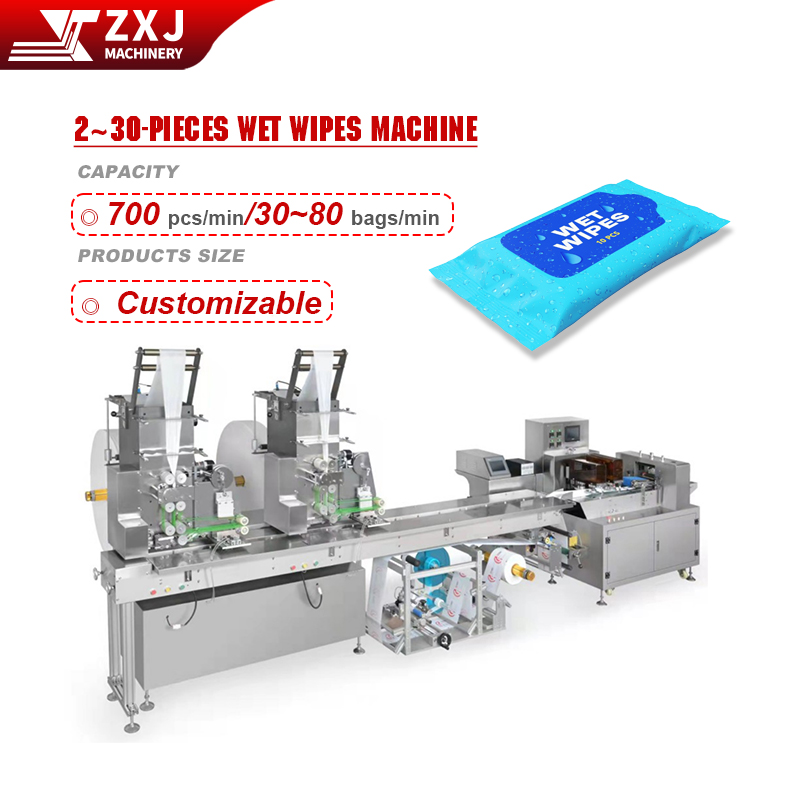
Historically, converters relied on split configurations—combining a standalone folding unit with an external flow wrapper via linking conveyors. However, split systems introduce stack synchronization delays, require expansive workshop footprints, and demand higher labor overhead. This engineering guide evaluates the integrated mono-block alternative, using the ZXJ YWJ-WP-2 Fully Automatic 2–30 Piece Wet Wipe Production Line as an operational baseline.
1. Integrated Mono-Block vs. Split Converting Lines
When setting up a high-efficiency pocket wipe facility, factory owners must balance initial capital expenditure (CAPEX) against ongoing operational simplicity. The table below illustrates the critical structural differences between traditional split lines and the integrated YWJ-WP-2 mono-block layout.
| Evaluation Metric | Conventional Split Line (Folder + External Wrapper) | Integrated Mono-Block (YWJ-WP-2) |
|---|---|---|
| Machine Dimensions | 8.0 m – 12.0 m total length (requires bridging conveyors) | 5.0 m (L) × 2.0 m (W) × 1.9 m (H) |
| Floor Space Required | ~25–35 m² minimum operating clearance | ~10–12 m² compact single footprint |
| Labor Requirement | 2 to 3 operators per shift (manual feeding & alignment) | 1 operator per shift (roll staging & pack-off) |
| Stack Transfer Reliability | High risk of stack collapse or skew on transition belts | Direct positive servo transfer into the bag-forming shoulder |
| Total Connected Power | Typically 15.0 kW – 22.0 kW | 9.5 kW (3-Phase 380V, 50Hz) |
2. Synchronized Output: Folding Speed vs. Packaging Speed
A common mistake in equipment procurement is treating raw folding speed as finished throughput. The YWJ-WP-2 datasheet lists two distinct baseline ratings:
- Folding Capacity: 20 – 700 pieces/minute
- Packaging Output: 20 – 60 finished packs/minute
- Target Stack Height: 1 – 60 mm
The operational balance is governed by a straightforward equation:
Required Folding Speed = Target Packaging Output (packs/min) × Pieces Per Pack. Review the operating parameters across standard SKU formats:
| Target SKU Format | Flow Wrapping Speed | Required Folding Rate | Machine Operating Load |
|---|---|---|---|
| 10-Count Travel Pack | 50 packs/min | 500 pieces/min | Optimal (71% of max folding capacity) |
| 20-Count Pocket Pack | 30 packs/min | 600 pieces/min | Optimal (85% of max folding capacity) |
| 5-Count Mini Wipes | 60 packs/min (Wrapper Max) | 300 pieces/min | Wrapper-bound (Low mechanical wear on folder) |
3. Automation Architecture and Critical Component Standards
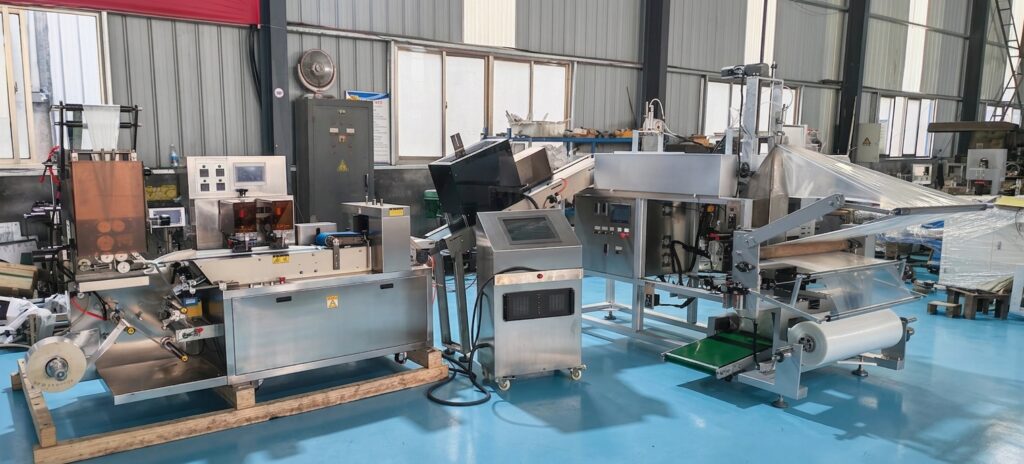
Unscheduled mechanical downtime immediately destroys converting margins. For overseas facilities, reliability is directly determined by the quality of motion control and component accessibility. The YWJ-WP-2 uses a multi-axis servo architecture, eliminating mechanical drive gear play:
- Centralized Motion Controller: Equipped with a dedicated Z-Motion (正运动) 432-40 bus controller providing microsecond electronic cam synchronization between web unwinding, precision cut-off, and film pulling.
- Independent Multi-Axis Servo Topology: 7 high-torque servo motors govern critical stations, including film pulling, longitudinal back-sealing (1.5 kW), rotary cross-cutting (2 × 0.75 kW), stack infeed (0.75 kW), and nonwoven pull rollers (2 × 0.75 kW).
- International Electrical Protection: Low-voltage circuit breakers (1PC10 and 2PC25), emergency stops, and pushbuttons are standardized on Schneider Electric. This ensures overseas maintenance teams can source identical replacements locally without factory import delays.
- Heating & Logic Switching: Configured with Omron miniature relays (MY2NJ) and Chint solid-state relays (SSR-25DA) to maintain precise temperature stability on longitudinal and cross-seal heater bars.
[Media Placeholder: Electrical Cabinet & Forming Tooling Photo]
Insert close-up image: Showing organized Schneider switchgear, Z-Motion controller, and precision rotary cutting cylinder.
4. Comprehensive Converting & Packaging Specification Matrix
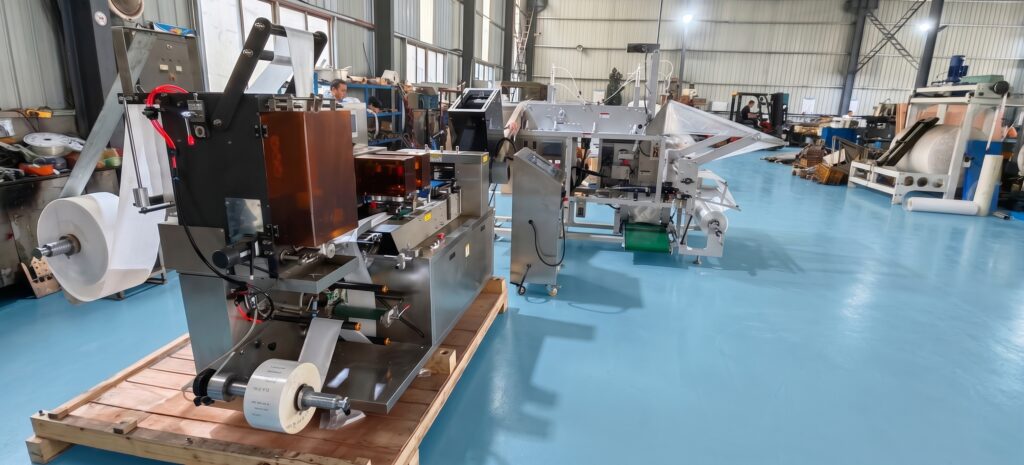
Before issuing a formal RFQ, compare your product drawings against the verified forming and packaging parameters below:
| Parameter Group | Engineering Range | Production Notes & Compatibility |
|---|---|---|
| Nonwoven Fabric Scope | 35 – 100 g/m² (GSM) | Compatible with Spunlace and Hot-Air (Through-Air) nonwovens |
| Unfolded Wipe Dimensions | Length: 110–260 mm Width: 120–280 mm | Parent nonwoven web width: 80–280 mm |
| Folded Wipe Dimensions | Length: 55–130 mm Width: 55–80 mm | Widthwise half-fold or N-fold, then lengthwise half-fold |
| Parent Roll Diameters | Nonwoven: ≤ 1,000 mm Packaging Film: ≤ 400 mm Label Roll: ≤ 320 mm | All roll unwind stations utilize standard 3-inch (75 mm) inner cores |
| Liquid Dosing Skid | 450L pneumatic mixing tank | Immersion bath with sanitary diaphragm dosing pump |
| Packaging Film Types | OPP, PET, Metallized, Pearlized, Laminated Paper | Thickness: 60–100 μm (optimal run range: 70–80 μm) |
| Resealable Opening & Label | Oval Punch: 15×30, 20×40, 30×60 mm Label: L30–200 mm, W20–100 mm | Synchronized optical eye-mark label registration |
| In-line Batch Coding | Dikai (迪凯) mechanical ribbon coder | Thermal transfer overprinter (TTO) available on request |
5. Commercial Payback & ROI Analysis
For plant managers and financial controllers, the primary commercial metric is total cost of ownership (TCO) and rapid capital payback. Below is a baseline economic projection based on continuous 10-count pocket wipe production:
| Operating Metric | Single-Shift (8 Hours) | Double-Shift (16 Hours) |
|---|---|---|
| Net Operating Hours (85% OEE) | 6.8 hours net run time | 13.6 hours net run time |
| Daily Output (50 packs/min) | 20,400 finished packs | 40,800 finished packs |
| Monthly Output (25 Operating Days) | 510,000 packs/month | 1,020,000 packs/month |
| Direct Labor Savings (vs. Split Setup) | 1 Operator Saved ($18,000/yr) | 2 Operators Saved ($36,000/yr) |
With direct labor savings of $36,000 to $72,000 per year (depending on regional wage rates) alongside minimal energy consumption (9.5 kW total load), most converters achieve full capital payback within 6 to 9 months of commercial commissioning.
[Media Placeholder: Overseas Client Warehouse Photo]
Insert customer warehouse image: Palletized 10-count wipe cartons stacked ready for retail distribution beside the running YWJ-WP-2 line.
6. Sourcing & RFQ Engineering Checklist
When submitting an inquiry for quotation and tooling customization, ensure your engineering team provides the following five parameters:
- Finished Wipe Geometry: Unfolded sheet dimensions (Length × Width), folded size, and target piece count.
- Substrate Profile: Nonwoven fabric type (Spunlace or Hot-Air), GSM rating (35–100 g/m²), and core diameter.
- Formulation Chemistry: Alcohol content (75% ethanol requires explosion-proof safety isolation), water-based sanitizers, or cosmetic lotions.
- Film & Packaging Design: Foil barrier structure, film thickness (60–100 μm), and die-cut opening dimensions.
- Utility Infrastructure: Three-phase power voltage/frequency (standard 380V/50Hz or custom 220V/480V transformer) and compressed air supply (≥ 0.6 MPa).
Frequently Asked Questions (FAQ)
Can the YWJ-WP-2 produce 75% alcohol disinfectant wipes safely?
Yes. When running alcohol or volatile solvent formulations, the machine can be specified with explosion-proof drive motors, anti-static discharge bars, and enclosed liquid bath hoods to prevent vapor accumulation.
What is the typical changeover time between different pack counts?
Changing piece counts (e.g., from 10-count to 20-count) using the same fold width is managed digitally via the touchscreen recipe database and takes approximately 15 to 25 minutes. A complete changeover involving a different bag former and film roll swap takes roughly 35 to 45 minutes.
Can this machine connect to an automated downstream cartoning line?
Yes. The outfeed conveyor can be seamlessly connected to continuous-motion top-load or horizontal case packers, auto-bundlers, or checkweighers for end-to-end hands-free packaging.
How does the unwind station prevent lightweight spunlace fabric from stretching?
The dual unwind stands incorporate adjustable mechanical dampening tensioners paired with dual-stage servo pulling rolls. This isolates roll inertia and ensures zero web elongation even on delicate 35–45 g/m² fabrics.
Request an Engineering Consultation & Formal Quotation
Send your wipe drawings, target roll parameters, and packaging requirements to our applications team for a complete line sizing assessment:
Direct WhatsApp: +86 158-9610-9075
Engineering Email: paul@zxjmachinery.com
Plant Address: Taiping Industrial Park, Lianyungang City, Jiangsu Province, China