Greaseproof paper looks like a commodity — until you trace where it ends up. Burger wrap, fry bags, steamer liners, baking sheets, air-fryer paper: one raw material feeds a dozen stable, high-frequency food categories. Two forces are now rewriting who wins in this space: the shift to PFAS-free (fluorine-free) paper, and the shift from selling raw rolls to selling finished, pop-up, ready-to-pack sheets.
Global Demand for PFAS-Free Greaseproof Paper: Suppliers vs. Buyers
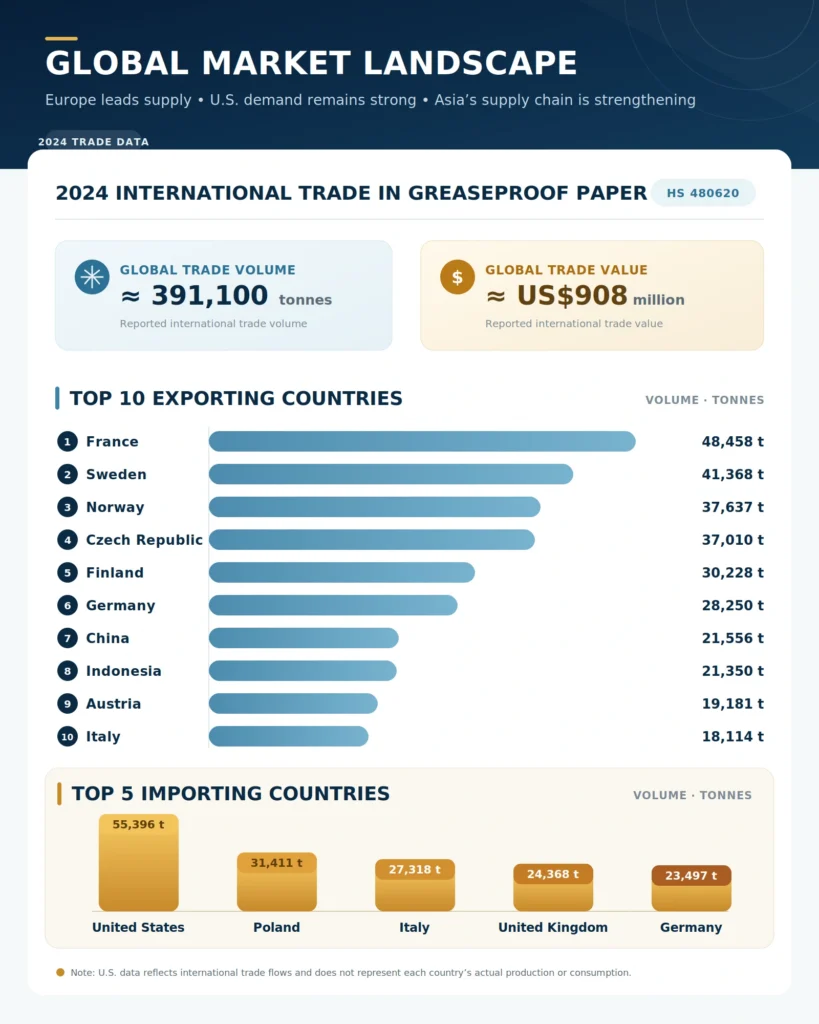
Based on 2024 HS 480620 (greaseproof paper) trade data, global trade volume ran approximately 391,000 tonnes, worth roughly US$908 million.
| Region | Role | Key countries |
|---|---|---|
| Supply | Export-heavy | France, Sweden, Norway, Czech Republic, Finland, Germany |
| Rising supply | Growing fast | China (~21,556 t), Indonesia |
| Demand | Import-heavy | United States (~55,396 t), Poland, Italy, UK, Germany |
The takeaway: the U.S. is the single largest buyer, Europe is deep but certification-heavy, and Asian supply — including China — is gaining share. That gap between where the paper is made and where it’s consumed is exactly where a processing and export strategy pays off.
Silicone Paper and Greaseproof Paper: One Material, Six Different Jobs
The mistake many converters make is treating “greaseproof” as a single spec. In practice, each food application demands a different balance of properties:
| Food category | Typical products | What matters most |
|---|---|---|
| Fried food | Burger wrap, fry bags, tray liners | Grease resistance, wet strength, moderate breathability |
| Bakery | Bread bags, donut bags, cake liners | Breathability, low odor, softness |
| Steamed food | Bun paper, dim sum liners | Steam resistance, non-stick, perforation |
| Baking | Baking sheets, cake release paper | High heat resistance (200°C+), non-stick, low odor |
| Air fryer | Fryer liners, paper bowls | Heat + oil/water resistance, shape stability |
| Frozen isolation | Patty paper, bacon liners | Cold flexibility, non-stick, moisture resistance |
This is also why converting equipment matters as much as the raw paper: a machine that can only produce one sheet size or one fold type locks a factory into a single niche, while flexible tooling opens several categories at once.
Why PFAS-Free Greaseproof Paper Is Now the Baseline
For years, fluorine-based treatments were the easy route to high grease resistance. That’s changing fast: U.S. and EU regulators are tightening PFAS restrictions, and major foodservice brands are actively phasing out fluorinated packaging. For a supplier entering mainstream American or European retail and QSR supply chains, PFAS-free / total-fluorine testing is now a baseline requirement, not a premium add-on.
Buyers typically expect a document package covering: FDA 21 CFR 176 compliance, EU 1935/2004 and EC 2023/2006 declarations, LFGB/BfR reports, PFAS-free or total-fluorine test results, food-contact migration testing, FSC certification, food-grade ink/adhesive/coating declarations, TDS/COA/MSDS, and BRCGS Packaging or ISO 22000/HACCP certification.
Why a Silicone Paper Folding Machine Beats Selling Raw Rolls
Raw greaseproof paper is high-volume, thin-margin, and price-transparent, dominated by established European mills. The more defensible position — better suited to China’s manufacturing strengths — is moving down the value chain:
Fluorine-free base paper → coating/silicone treatment → printing → slitting → folding/bag-making/die-cutting → export-ready finished product
That extra step changes who you can sell to: packaging distributors, foodservice suppliers, bakery chains, and cross-border e-commerce brands, at better margins and with stickier customers once your sheet size, print, and certification package are built into their spec.
The Silicone Paper Folding Machine Behind Pop-Up Deli Paper
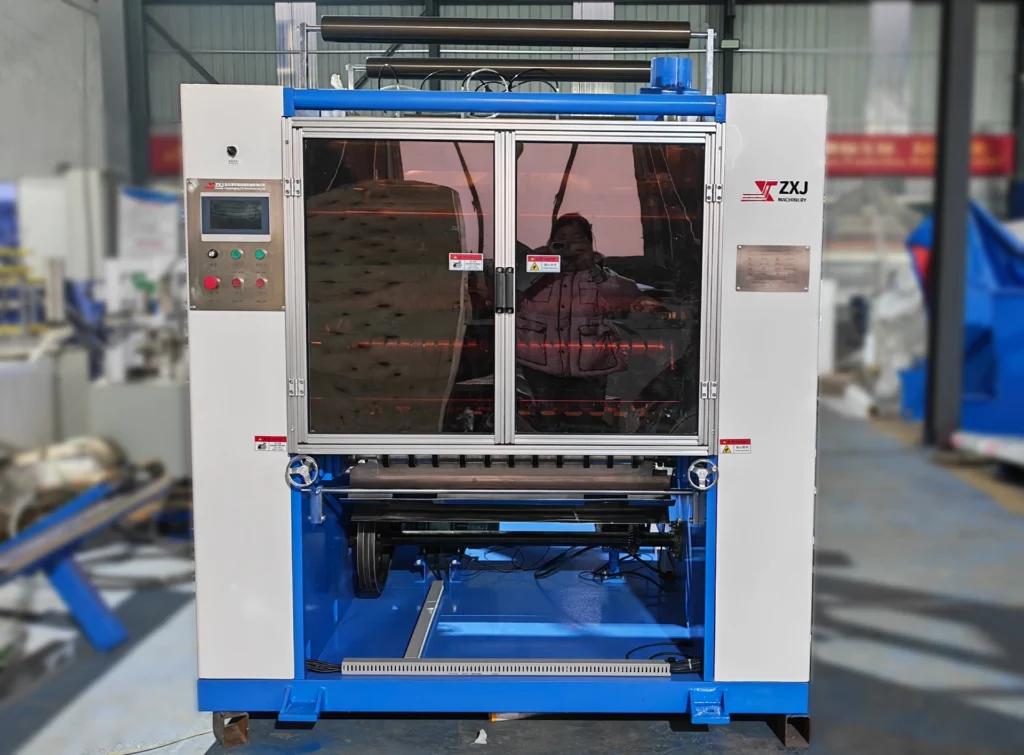
This is where an extractive (pop-up) silicone paper folding machine earns its place in the process. Instead of shipping paper as flat stacks or plain rolls, this equipment interfolds and cuts the sheet so each piece “pops up” the next one when pulled from a box — the same dispensing format buyers expect from commercial deli paper, wax paper, and baking sheets.
YHZY-PF-915 Silicone Paper Folding Machine Specifications
| Spec | YHZY-PF-915 |
|---|---|
| Max raw material width | 915 mm |
| Finished sheet size | 273 mm length × 6″ / 8″ / 10″ / 12″ width |
| Output speed | 900–1,200 sheets/min |
| Counting accuracy | ±1‰ |
| Power | 5 kW |
| Control | Delta touchscreen, automatic tension control |
| Configuration | Multi-lane simultaneous production; horizontal tailstock with pneumatic loading available |
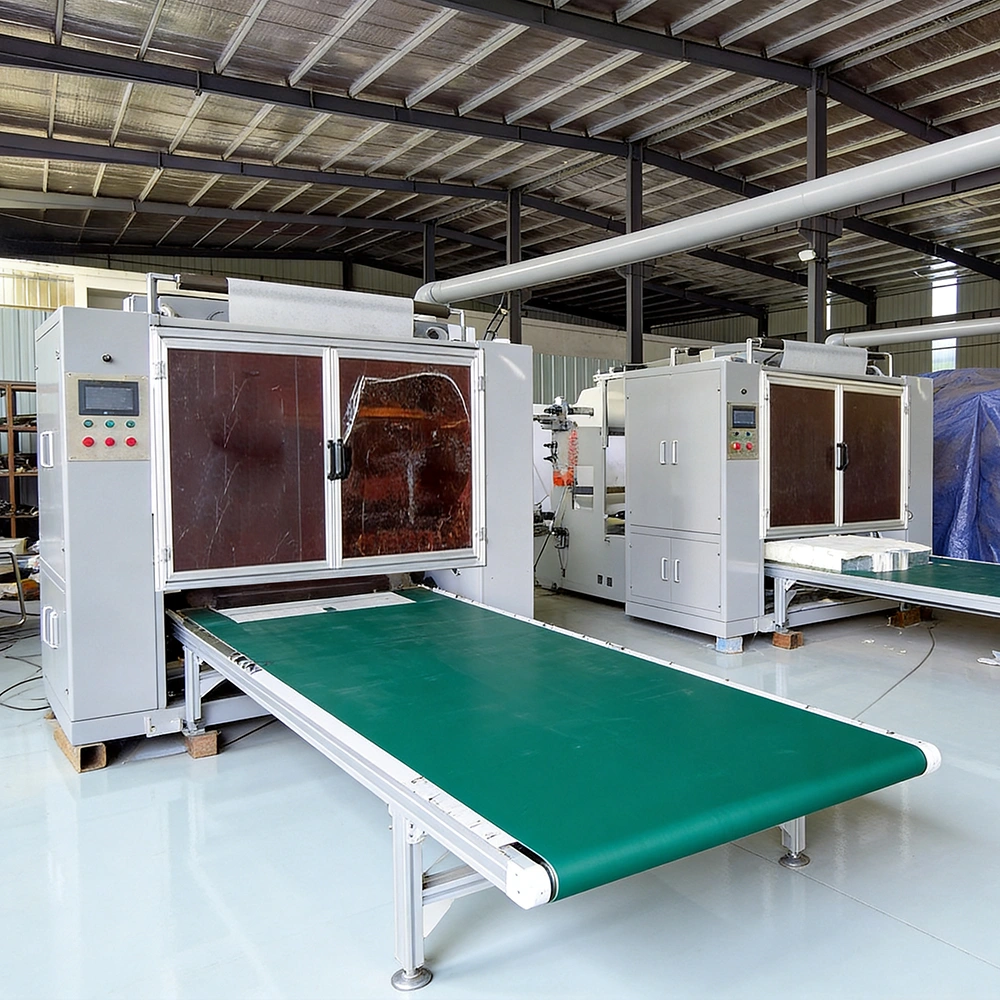

A companion rewinding line handles smaller roll formats (120–500 mm finished width, 0–200 m/min, 6 kW) for buyers who want small consumer rolls instead of pop-up boxes — useful when one factory is supplying both foodservice and retail channels from the same base paper.
Choosing the Right Silicone Paper Folding Machine for Export
The three product lines worth prioritizing now are PFAS-free fast-food wrap (burger, fried chicken, fry bags), baking and steamer paper, and air-fryer paper — categories where certification, sheet precision, and pop-up convenience directly decide which supplier gets the repeat order. Raw material sourcing matters, but the factories winning long-term contracts are the ones that can also fold, cut, count, and box the finished sheet without curled edges or wasted material.
If you’re moving from raw paper or basic sheeting into certified, pop-up-ready deli and baking paper, our engineering team can review your target sheet sizes and output volume and put together a machine configuration and ROI estimate.
FAQ
Q1: What is an automatic food packaging line for interfolded deli paper?
It’s an integrated workflow that converts rolls into interfolded pop-up sheets, batches accurately, and connects to boxing/cartoning for retail-ready output.
Q2: Can interfolded deli paper production be semi-automatic first?
Yes. Many plants start with stable converting + controlled batching, then add boxing/cartoning automation after output stabilizes and demand grows.
Q3: Why does downstream automation fail in pop-up products?
Most failures are caused by inconsistent sheet length, unstable interfold overlap, or count drift—downstream equipment can’t compensate for inconsistent upstream output.
Q4: How do I scale output without losing dispensing quality?
Scale through column/lane strategy and stable process windows, then match downstream packing speed with buffers between modules.
Build Your Interfolded Deli Paper Production Line
📩 Get a Quote / Contact Us
for machine specifications, video demonstrations, and a detailed quotation.
WhatsApp: +86 158-9610-9075
Email: paul@zxjmachinery.com
For detailed specifications and model options, visit our
🔗Interfolded Deli Paper Production Line
🔗Pop-Up Wax Paper Folding Machine Process & Patent-Protected Design