
Pop-up formats are moving from “nice-to-have” to a mainstream packaging choice in foodservice and retail. Buyers want pre-cut deli paper that dispenses cleanly, one sheet at a time, and brand owners want packs that look consistent on shelves. For manufacturers, that demand creates a new requirement: not just a folding machine, but a repeatable, scalable automatic food packaging line.
This article focuses on line integration. We’ll break down how an interfolded wax paper machine (often searched as a pop-up wax paper folding machine or wax paper interfolder) fits into an end-to-end workflow—so you can plan capacity, reduce manual handling, and keep pack counts stable.

What “Automatic Food Packaging Line” Means for Interfolded Deli Paper Production
In interfolded products, the “line” is not defined by one machine. It’s defined by how consistently you can convert material into:
- Uniform sheet size (fixed-length cutting)
- Stable interfold geometry (for one-by-one dispensing)
- Predictable batching (accurate counts for retail packs)
- Smooth downstream packing (boxing/cartoning/shrink/wrapping)
If any one of these is unstable, automation downstream becomes fragile. That’s why line planning starts from the converting module—because it determines the quality and repeatability of everything that follows.
Item | Specification |
Pop-up wax paper folding machine / interfolded wax paper machine | |
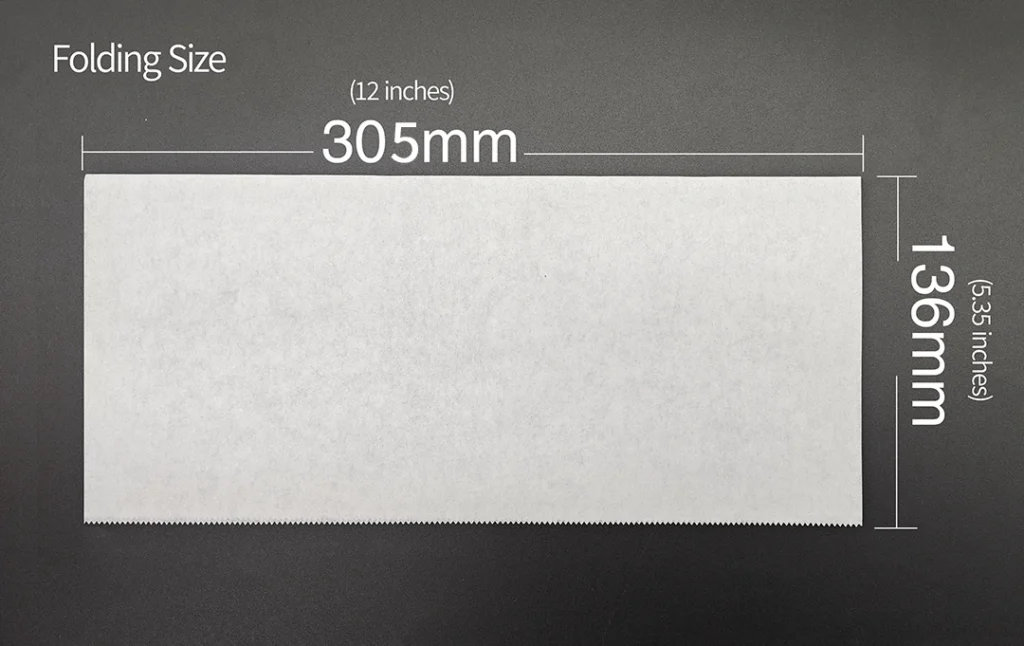
Finished sheet (unfold) | Length: 273 mm (customizable, fixed size); Width: 6”, 8”, 10”, 12”, 15” etc. |
Fold type | V-fold cross fold, continuous extraction type |
Applicable materials | 28–50 GSM silicone oil paper or wax paper |
Paper core | 76 mm (3 in.) |
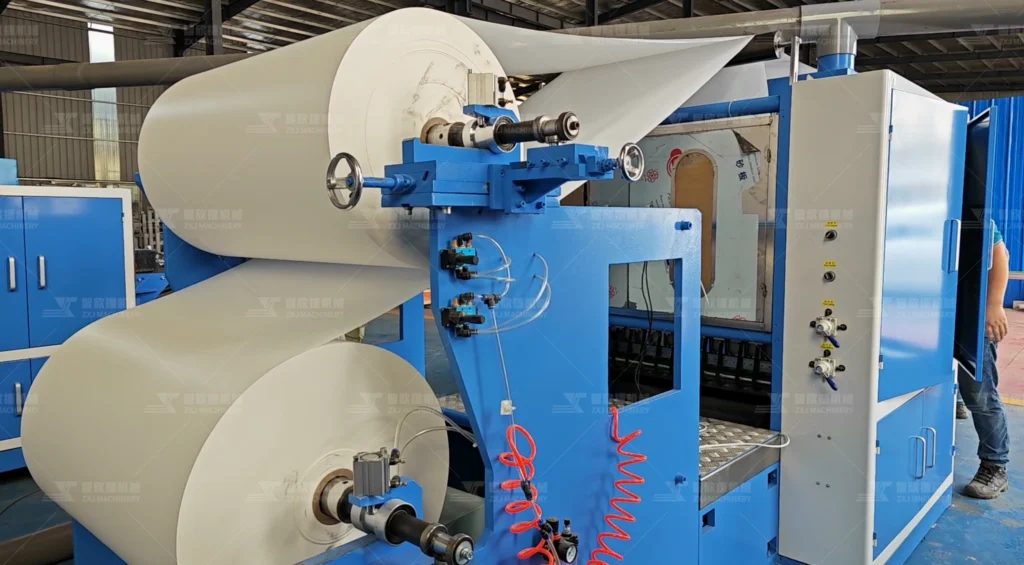
Max raw roll | ≤ Φ1000 mm, max width 915 mm |
Output capability | Single column 300–400 sheets/min; common layouts: 305 mm 3 columns / 228 mm 4 columns |
Control | 7-inch touch screen, touch control |
Power | Roots blower 22 kW; Main motor 4 kW; Tension motor 2 kW; Feed-out conveyor 400 W |
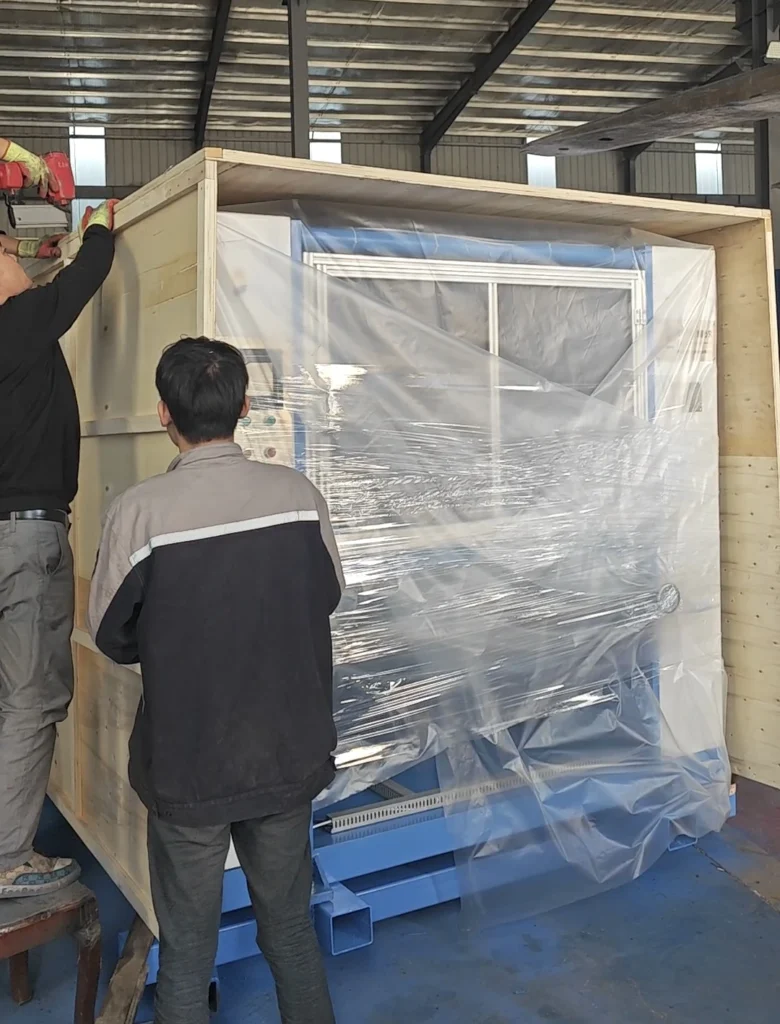
Machine size | Host: 6800×2150×2350 mm; Roots blower: 2300×800×2600 mm |
Gross weight | 6500 kg |
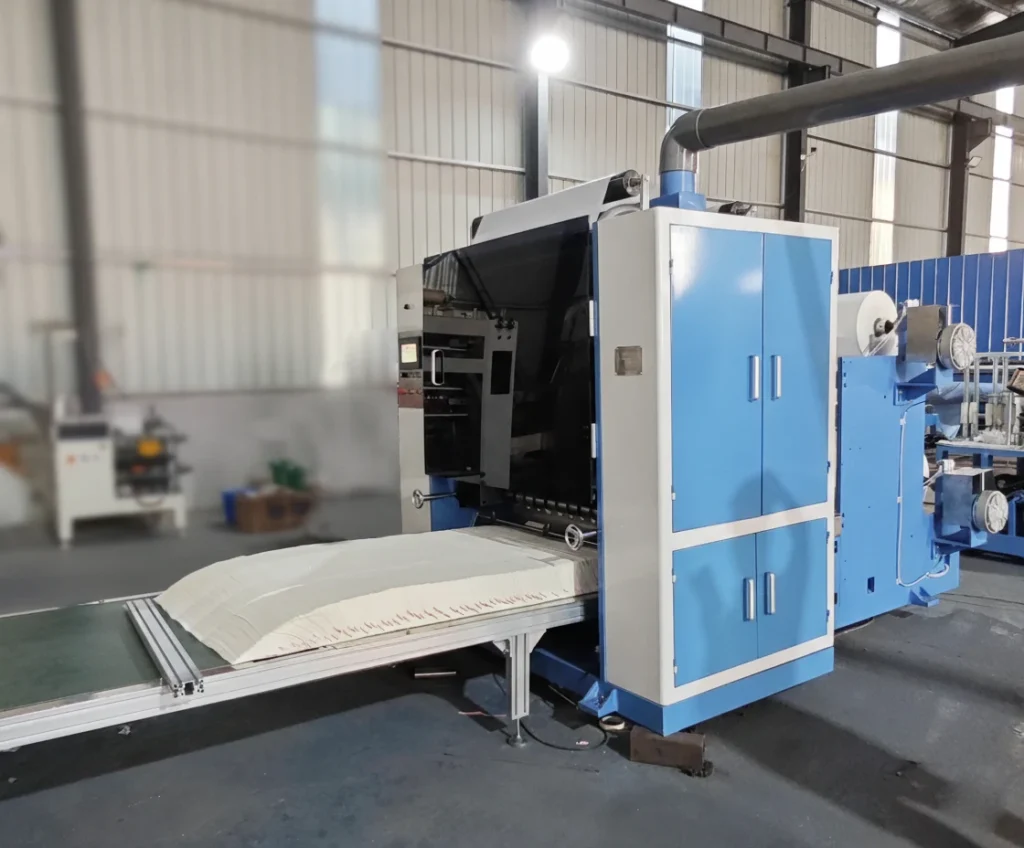

Line Architecture Overview (From Roll to Finished Retail Packs)
An interfolded wax paper machine (also called a wax paper interfolder) converts roll stock into V-fold cross fold sheets designed for continuous extraction in dispenser boxes. This finished format is widely used for:
Module 1 — Roll Unwinding and Web Control
Goal: keep the web stable and aligned before cutting and folding.
Key planning points:
- roll diameter and width range
- core specification
- tension stability (wrinkles are automation killers)
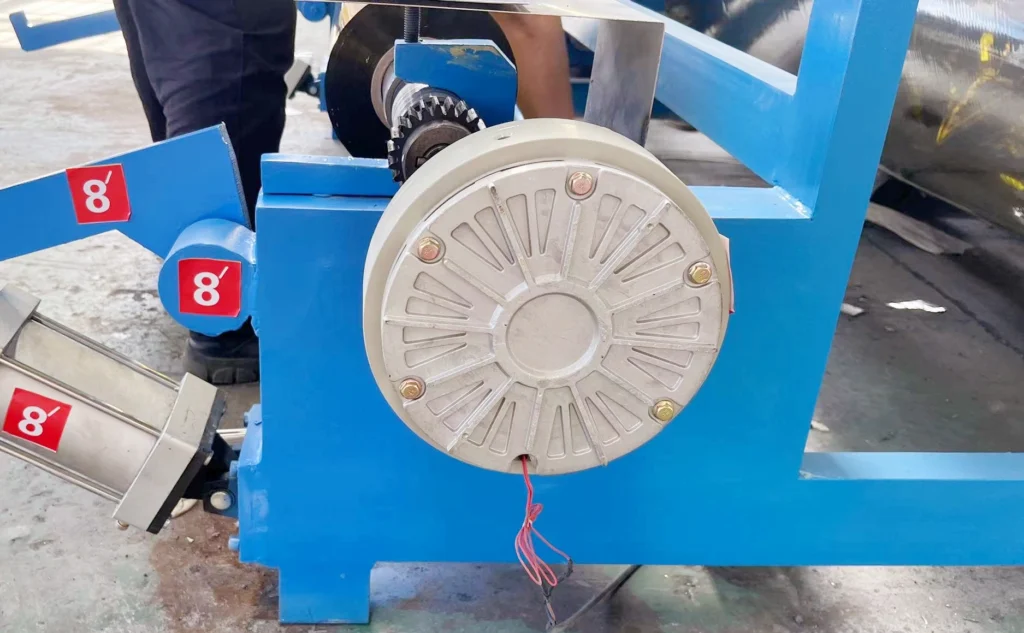
Module 2 — Fixed-Length Cutting for Pre-Cut Deli Paper
Goal: cut sheets to a consistent length to stabilize overlap and pack height.
Why it matters:
- length drift changes interfold overlap
- overlap drift causes double-pull, tearing, and dispenser complaints
- inconsistent pack height creates boxing problems
Module 3 — Interfolding (Pop-Up Formation)
Goal: form an interfold structure (commonly V-fold cross fold) that supports continuous extraction.
Automation impact:
- fold repeatability determines “one-at-a-time dispensing” performance
- stable overlap reduces downstream defect sorting
Module 4 — Counting, Batching, and Controlled Discharge
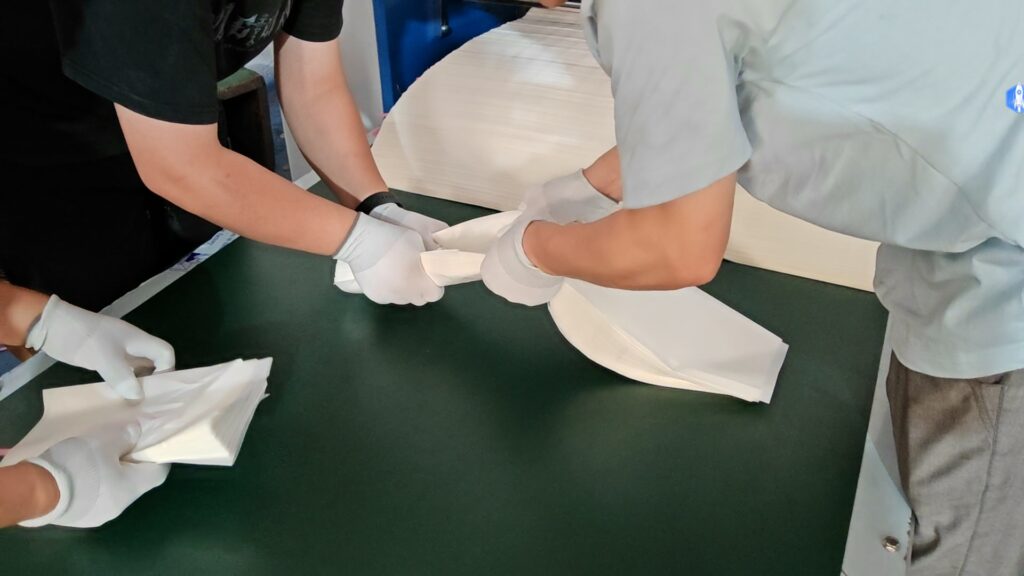
Goal: output consistent batches that match your retail pack count.
Automation impact:
- accurate batching reduces manual recounting
- stable discharge enables reliable boxing/cartoning rhythm

Module 5 — Downstream Packing (Boxing/Cartoning/Labeling)
Goal: turn batches into retail-ready packs with minimal manual touch.
Common downstream options:
- manual/semi-auto boxing for early-stage production
- automatic box forming + loading + closing for high-volume brands
- cartoning + case packing for enterprise procurement
The Role of the Pop-Up Wax Paper Folding Machine in Line Integration
A folding machine becomes “line-ready” when it does three things well:
1) Outputs sheets that dispense reliably
If the interfold geometry is unstable, you may still “pack boxes,” but customers will complain about tearing, jamming, or double pulling. A line that scales must protect the end-user experience.
2) Holds accuracy under speed
A high-speed converting line is only profitable if quality stays stable at production speed. When fold or count drift increases at higher speed, you lose output to rework and downgrade.
3) Produces batches compatible with automation downstream
Downstream packing systems want:
- consistent batch size (count)
- consistent stack orientation
- consistent pack height and edges
If the output is inconsistent, automation becomes expensive and unreliable.
Capacity Planning: How to Scale Without Breaking Stability
Many buyers assume scaling means “run faster.” For interfolded products, scaling is usually better achieved through:
- lane/column strategy (more columns rather than overstressing one column)
- stable material window (match paper GSM and coating behavior to your line)
- balanced downstream rhythm (boxing speed must match converting output)
A practical planning approach
- Step 1: define your finished sheet width and pack count
- Step 2: choose the most stable column configuration for that width
- Step 3: design downstream packing speed to match converted batches
- Step 4: reserve buffer zones (accumulation) between converting and packing to absorb micro-stops
This is how you build a line that runs for shifts—not just for demos.
“Sustainable Deli Wrap Solution” Positioning — How to Make It Real
Many brands market paper-based wraps as a sustainability improvement. From a manufacturing point of view, sustainability messaging becomes credible when you can deliver:
- consistent sheet sizes (reducing waste)
- standardized packs (less rework and scrap)
- stable production (fewer rejected batches)
- packaging designed for efficient dispensing (less overuse at the customer site)
In other words, your line efficiency supports the sustainability claim—without needing exaggerated promises.
Common Integration Problems (And How to Prevent Them)
Problem 1 — Wrinkles and misalignment create packing jams
Prevention:
- prioritize web control and tension stability
- keep the converting output uniform before attempting full automation
Problem 2 — Count drift forces manual recounting
Prevention:
- implement stable counting and batching logic
- ensure discharge keeps batch integrity intact
Problem 3 — Dispensing complaints after shipment
Prevention:
- validate pop-up extraction performance during trials
- test at production speed, not only slow speed
- confirm dispenser box match (opening size, friction, stack compression)
What to Prepare Before You Design an Automatic Packaging Line
To receive a serious line proposal (not a generic quote), prepare:
- Product types: pre-cut deli paper / pop-up wax paper / burger wrap sheets
- Material range: paper type + GSM + coating behavior
- Finished sheet size: length + width
- Pack formats: sheets per box, box dimensions, brand packaging requirements
- Target output: per shift/day, planned number of shifts
- Automation level: manual boxing now vs future cartoning/case packing
- Plant constraints: power standard, available footprint, operator count targets
FAQ
Q1: What is an automatic food packaging line for interfolded deli paper?
It’s an integrated workflow that converts rolls into interfolded pop-up sheets, batches accurately, and connects to boxing/cartoning for retail-ready output.
Q2: Can interfolded deli paper production be semi-automatic first?
Yes. Many plants start with stable converting + controlled batching, then add boxing/cartoning automation after output stabilizes and demand grows.
Q3: Why does downstream automation fail in pop-up products?
Most failures are caused by inconsistent sheet length, unstable interfold overlap, or count drift—downstream equipment can’t compensate for inconsistent upstream output.
Q4: How do I scale output without losing dispensing quality?
Scale through column/lane strategy and stable process windows, then match downstream packing speed with buffers between modules.
Build Your Interfolded Deli Paper Production Line
📩 Get a Quote / Contact Us
for machine specifications, video demonstrations, and a detailed quotation.
WhatsApp: +86 158-9610-9075
Email: paul@zxjmachinery.com
For detailed specifications and model options, visit our
🔗Interfolded Deli Paper Production Line
🔗Pop-Up Wax Paper Folding Machine Process & Patent-Protected Design