Napkin paper machine Introduction
In a world increasingly conscious of hygiene, convenience, and disposable tableware, paper napkins remain a staple across households, restaurants, hotels, and event catering. But behind every stack of crisp, folded napkins lies a complex instrumentation network: the paper napkin making machine. This guide aims to pull back the curtain on these machines — how they work, what differentiates models, how to evaluate costs, and how to convert that into a profitable wholesale or in-house supply business.
You will learn:
- The full manufacturing process from raw roll to folded napkin
- The major machine components and functions
- Quality control strategies and standards
- The variants: semi-automatic vs. fully automatic, tissue vs. interfold/dispensers
- Price ranges and cost drivers
- Wholesale sourcing and distribution logic
- Strategic advantages of investing in a napkin machine
Let’s dive in.
1.Overview of Paper Napkin Making Machines
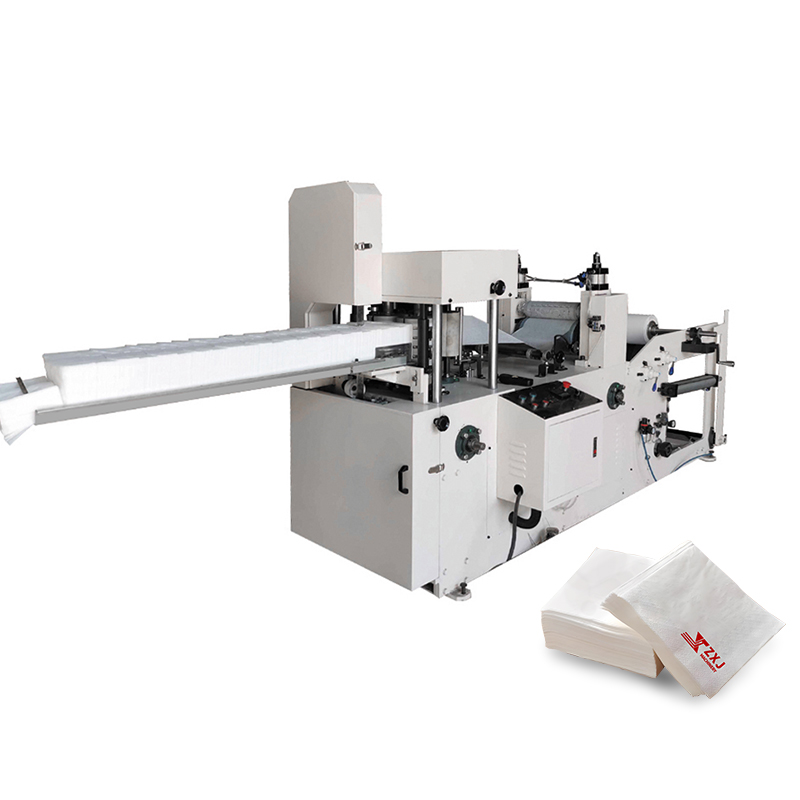
A paper napkin making machine transforms jumbo tissue rolls into cut, embossed, folded, counted, and packaged napkins. Most machines integrate several functions, including printing, embossing, gluing and lamination, cutting, folding, and stacking. They form the core of the tissue converting industry, determining efficiency, quality, and profitability.
Business Value and Market Demand of Paper Napkin Production
Why invest in napkin production? Some drivers:
- High and stable demand: Food service, hotels, airlines, events all consume napkins at scale.
- Branding / customization: Embossed logos, printed designs, special folds differentiate in B2B markets.
- Cost control / margin capture: Producing your own rather than outsourcing allows capture of the converting margin.
- Scalability: Automation allows you to scale with lower marginal labor costs.
- Export / wholesale opportunity: Napkins are light, non-perishable, and widely needed — good candidate for volume trade.
If you’re aiming at B2B/hygiene markets, knowing the technical backbone gives you leverage.

2.Understanding the Manufacturing Process
Here is a simplified but actionable flow of how paper napkins go from raw roll to boxed product.
The Steps Involved in Paper Napkin Manufacturing
| Stage | Description | Key Considerations / Risks |
|---|---|---|
| Raw material feed / unwind | Jumbo tissue rolls (single or multi-ply) are loaded into unwind stands | Width, diameter, core size, tension control |
| Embossing / bonding | If 2-ply or decorated napkins, an embossing unit may bond and texture the layers | Embossing pressure, pattern alignment, adhesive (if used) |
| Cutting / slitting | Roll is slit or cut transversely into sheet lengths | Knife sharpness, registration accuracy, waste margin |
| Folding / stacking | Sheets are folded in the required pattern (¼ fold, Z fold, C fold, etc.) and stacked | Folding pitch, stack height, knife alignment |
| Counting / sensor check | Electronics count units, detect misfolds, mark defective pieces | Sensor calibration, error rejection logic |
| Interleaving / stacking (if dispensing napkins) | Napkins may be interleaved so dispensing is smooth | Interleaving quality, latch timing |
| Packaging / bagging / cartoning | Napkin stacks go to packaging (bags, wraps, cartons) | Packaging speed, sealing quality, synchronization |
| Palletizing / warehousing | Packaged units are palletized for shipping | Pallet stability, protective packaging |
In many integrated lines, one “napkin machine” may handle embossing, cutting, folding, counting — and then feed into a standalone packaging machine.
Raw Materials Used
- Base paper / tissue: Grammage (13-25 g/m² typical), single- or multi-ply.
- Adhesive / bonding chemicals: For multi-ply or laminated napkins.
- Ink / dyes / printing chemistry: If logos or colored prints are required.
- Packaging film / paper: For shrink wraps or sachets.
- Spare parts / consumables: Cutting knives, belts, embossing rollers, sensors.
Selection of base paper (quality, tensile strength, absorbency) heavily affects finished napkin feel, tear, absorbency, and reject rate.
3.Machinery Components and Functionality
To engineer or evaluate a napkin line, you must understand the mechanical/electrical subsystems. Below are the core modules:
- Unwinder / Tension Control
Maintains stable feed of parent roll, accounts for roll diameter changes, adjusts tension to prevent web breaks or stretch. - Embossing Unit
Uses steel-to-wool, steel-to-steel, or steel-to-cloth roller sets to embed patterns or bond plies. - Slitting / Cutting Unit
Rotary or knife mechanisms to cut across or along the web. Precision and registration are crucial. - Folding / Folding Head
Can support quarter-fold, half-fold, Z-fold, M-fold, or custom folds. May include vacuum or compressed air assist for folding. - Counting & Sensor Module
Electronic sensors monitor sheet count, misfold flags, transport speed, skip logic. - Stacking / Interleaving
Suitable for fully automatic high-speed machines. - Conveyance / Transfer Units
Belts, rollers, guides ensure smooth transfer from module to module without misalignment. - Control System / PLC / HMI
For fully automatic machine configuring speed, fold type, sensor thresholds, alarms, diagnostics. - Safety, Guards & Enclosures
To protect operators from moving parts, high-speed knives, rollers. - Downstream Packaging Interface
Interface to wrapper, bagger, or cartoner. Must synchronize with upstream output.
Many systems also include features like servo drives, automatic fault recovery, and modular expandability.
4.Quality Control Measures
You can produce at scale, but if your reject rate is high, margins evaporate. Good QC embeds checks at each stage.
Common Checks & Measures
- Web tension and linear density: Ensures proper basis weight; if web is slack or tight, thickness variation may occur.
- Knife alignment & sharpness: Dull or misaligned blades cause ragged edges or tears.
- Fold accuracy / millimeter tolerances: Folds outside spec lead to stacking or packaging jamming.
- Embossing uniformity / pattern defects: Uneven embossing or registration misalignment degrade brand value.
- Sensor accuracy / misfold detection: Reject or divert defective napkins before packaging.
- Moisture / humidity control: Physical distortion can occur if humidity is not controlled in ambient conditions.
- Package weight / count verification: Ensure correct number of napkins per bag/box.
- Final inspection / sampling: Random sampling to lab test absorption, tear strength, color bleed, etc.
Adopting ISO 9001 or equivalent quality management systems is common among reputable manufacturers.
Process control can also include SPC (statistical process control) and OEE (overall equipment effectiveness) tracking.
5.Types of Paper Napkin Making Machines
The landscape of napkin machines is far from monolithic. Some major differentiations:
Tissue Paper Napkin Making Machines
These are machines designed specifically for tissue-grade base materials, with light grammage, delicate webs, fine embossing. Many integrate embossing + folding in one unit.
Interleaving / Dispenser Napkin Machines
Produces interfold (interleaved) napkins for dispensers, so each napkin is partially exposed to assist single-handed dispensing. Requires specialized stacking and nip timing.
Semi-Automatic vs. Fully Automatic Machines
| Feature | Semi-Automatic | Fully Automatic |
|---|---|---|
| Manual intervention | Requires manual stacking and transfer to the packaging machine | No manual work required; machine automatically stacks and transfers napkins to the packaging infeed |
| Throughput | Lower (100s sheets/min) | High (several hundreds to over a thousand) |
| Cost / CapEx | Lower upfront cost | Higher complexity and price |
| Control sophistication | Basic control / speed | PLC / servo / fault recovery |
| Integration potential | Standalone modules | End-to-end integrated lines |
| Maintenance demand | Often simpler | More sensors, calibration dependency |
Another axis: number of lanes. A “lane” means parallel folding paths: single-lane, two-lane, multiple-lane machines increase throughput by multiplying parallel operations.
Also, fold style support (¼, ½, Z, M, custom) is a differentiator.
6.Cost Analysis
Understanding the economics is critical if you’re evaluating ROI or choosing between models.
Paper Napkin Making Machine Price Range
From supplier listings and market data:
| Machine Category | Description | Price Range (USD) | Notes |
|---|
| Entry-level / Small Single-Lane Machines | Compact models ideal for startups and low-volume production | $4,000–$10,000+ | Low entry barrier; multiple models can be combined for flexible configurations |
| Mid-tier / Multi-Lane or Semi-Automatic Machines | Balanced option for medium-scale operations | $20,000–$50,000+ | Higher speed, |
| Fully Automatic High-Speed Multi-Lane Lines with Packaging | Integrated high-output production systems | $80,000–$300,000+ | Saves labor; fully automatic with integrated packaging |
On Alibaba, for example, “fully automatic napkin machine 800-900 pcs/min” is quoted in the range of approx USD ~9,000–12,000 for certain models.
Factors Influencing Prices
- Number of lanes / parallel paths
- Level of automation / control sophistication
- Supported fold types and flexibility
- Embossing / printing modules (1-2 color, custom logo)
- Build quality, component brand (motors, PLCs, bearings)
- Machine size, frame materials, design complexity
- After-sales service, spare parts, warranty
- Packaging integration downstream
- Customization / R&D costs
Comparing Prices Across Different Models
When you compare two machines, do not just compare speed or listed price. Normalize by:
- Cost per usable napkin (including scrap, downtime)
- Total cost of ownership: energy, spare parts, maintenance, staff
- Flexibility / upgrade potential
- Warranty / support / spare parts availability
Often a “cheaper” machine from unknown brand carries hidden risk (downtime, broken parts) that kills ROI.
7.Wholesale Opportunities & Distribution Strategy
If you’re producing napkins to sell wholesale (rather than internal consumption), these are key considerations.
Sourcing Wholesale Paper Napkins
You have two main pathways:
- Produce yourself: You control quality, cost structure, brand.
- Outsource / contract convert: For lower volumes, you contract a converter.
- Mix / hybrid: In-house for flagship SKUs, outsource for variant SKUs.
Potential Markets for Wholesale Napkins
- Hospitality / catering / hotels
- Restaurants / cafes / fast food chains
- Event planners / weddings / conventions
- Retail packaging (supermarkets selling napkin packs)
- Institutional (schools, prisons, hospitals)
- Export / OEM supply
You must align capabilities (fold type, custom print) with customer demands. For instance, many restaurants want napkins with logos; event planners want themed folds, colors.
Benefits of Investing in a Napkin Machine for Wholesale Distribution
- Higher margin capture (vs buying from a converter)
- Faster lead times / flexibility
- Control of quality / consistency
- Brand / custom differentiation
- Scalable growth
However, the risk is capital locked in machinery, maintenance overhead, and demand volatility.
8.Energy, Man power,Maintenance & Operating Cost Analysis
Energy Consumption & Power Usage
A responsible investor should calculate electricity cost per 1,000 napkins (or per hour). For example, a host machine might consume 4–7.5 kW at 380V three-phase (depending on size) plus auxiliary modules (cutters, embossers) ~1-2 kW.
Example:
| Machine Type | Power (kW)/hour | Daily Hours | Output Speed | Required Labor |
|---|---|---|---|---|
| Single-Lane Semi-Automatic Machine | 5 | 8 | 500 sheets/min | 6 |
| Multi-Lane Semi-Automatic Machine | 8.5 | 8 | 2000 sheets/min | 3 |
| Fully Automatic High-Speed Machine | 23 | 8 | 1500 sheets/min | 1 |
Maintenance & Spare Parts
- Regular preventive maintenance: lubrication, cleaning, belt tension checks.
- Knife / blade replacement: typically after certain hours or sheet count.
- Bearing / roller replacement: wear over time, especially in embossing units.
- Sensor / electronic calibration: sensors drift over time.
- Spare parts inventory cost: keep critical spares in stock to avoid long downtime.
- Downtime estimation: best practice is ≤10% downtime; high-end lines aim for 95%+ uptime.
Estimate annual maintenance as 3–10% of CapEx, depending on usage intensity.
Breakeven / ROI Example (Hypothetical)
Machine Type | Machine cost | Annual maintenance & energy cost | Capaciity/day(sheets) | Capacity/year(sheets) | Contribution margin per napkin | Annual profit | ROI | Payback |
Single-Lane Semi-Automatic Machine | $9,000 | $3,000 | 240,000 | 70,000,000 | 0.001 | $57,000 | 744% | <1 year |
Multi-Lane Semi-Automatic Machine | $20,000 | $9,000 | 960,000 | 288,000,000 | 0.001 | $233,000 | 1395% | <1 year |
Fully Automatic High-Speed Machine | $100,000 | $8,000 | 720,000 | 216,000,000 | 0.002 | $227,000 | 424% | <1 year |
*These figures are for reference only,real numbers depend heavily on local raw paper cost, labor, waste, utilization.
Suppose:Operating 300 days/year,
9. Integration, Modularity & Upgrade Paths
Rather than buying monolithic systems, a smart strategy is modular expansion:
- Start with a folding/cutting core, add embossing or printing later
- Use a modular control system (e.g. PLC / fieldbus) so new modules can plug in
- Design for machine compatibility with future packaging lines
- Plan for spare parts compatibility across model variants
- Consider retrofitting automated feeding / reel handling upgrades
This reduces risk and allows scaling.
10. Common Troubleshooting & Failure Modes
Here are recurring issues and remedies:
| Fault | Symptom | Root Possibilities | Remedies |
|---|---|---|---|
| Ragged cuts / tears | Edges frayed | Blade dull or misaligned | Re-sharpen blade; adjust alignment |
| Misfolds / skewed folds | Stack skewed | Folding head misalignment, vacuum issue | Recalibrate folding head; check vacuum supply |
| Web breaks / tears upstream | Breaks in paper web | Tension too high, brittle paper, foreign particle | Reduce tension, inspect paper quality, clean rollers |
| Emboss pattern out of sync | Patterns misregistered | Roll speed mismatch or chain slippage | Recalibrate embossing drive; tighten chains |
| Sensor miscounts / fails | Wrong counts | Sensor drift, dust, alignment | Clean sensors, adjust thresholds, perform calibration |
| Excessive noise / vibration | Abnormal sound | Bearing wear, loose parts | Inspect bearings, tighten frame bolts |
| Packaging mismatch (bags misaligned) | Bag seal off, jam | Speed mismatch upstream vs bagger | Sync speeds, buffer conveyors, tune PLC timing |
Document fault logs and establish continuous improvement cycles.
11. Installation & Factory Layout Guidelines
- Ensure level foundation and floor strength—machines are heavy, vibrations matter.
- Provide adequate clearance on sides for maintenance and belt routing.
- Plan power lines: Configure transformers based on standard regional voltages
- Compressed air system: many machines need clean, dry air (0.5–0.8 MPa typical) for pneumatic actuators.
- Dust management & exhaust ventilation: paper fibers can accumulate in the room.
- Humidity & temperature control: ideally 45–55% RH to avoid web tension issues.
- Operator walkway / shutdown safety zones: ensure operator access to HMI, emergency stop.
- Conveyor flow planning: infeed from roll stores, output path to packing / palletizing.
- Spare parts room, tool room, and access routes for heavy parts (cranes, fork lifts)
Good layout reduces collisions, improves safety, and future proofs expansion.
Final Thoughts (Revised Complete Version)
The paper napkin making machine is more than just a converting device — it’s the central nervous system of an efficient napkin supply operation. Mastering its process, components, and cost structure determines whether you end up with profits or perpetual downtime.
This extended guide has covered:
- The full manufacturing flow from base paper to boxed napkin
- Core machinery subsystems and functional modules
- Quality control and defect prevention
- Types and trade-offs (semi vs fully automatic, interfold, etc.)
- Detailed cost analysis, including energy, maintenance, and ROI
- Sustainability, modular upgrade strategies, and common troubleshooting
- Installation tips and layout guidance
If you’re vetting machine suppliers, combining this technical lens with site visits, sample production runs, and hands-on evaluations will serve you well.
External References
- FSC Certification Guidelines
- International Energy Agency – Industrial Efficiency Reports
- China Paper Association Technical Standards
Q1: What is the production capacity?
A1: 800–1200 sheets per minute; 80,000–120,000 per day depending on configuration.
Q2: What raw materials are used?
A2: Jumbo rolls (13–25 g/m²), glue, inks, and packaging film.
Q3: What’s included in a full line?
A3: Unwinder, embossing, cutting, folding, counting, and packaging units.
Q4: Power & maintenance costs?
A4: 6–7 kW average power; allocate 3–5% annual maintenance.
Q5: Custom logo printing?
A5: 1–2 color logo and packaging customization supported.
Ready to Invest in a Paper Napkin Production Line?
Share your production requirements today and receive detailed specs, production video, and quotation within 24 hours.
Or contact our engineering team directly:
- Email: paul@zxjmachinery.com
- WhatsApp: +86 158-9610-9075
We will help you with:
- Equipment configuration & layout planning
- Production cost & ROI analysis
- Certification and export documentation support